You've designed the perfect aluminum component. The CAD model looks flawless, the specifications are locked in, and your team is ready to move forward. Then comes the question that can make or break your project: should you use extrusion or casting to manufacture it?
This decision isn't just about picking a process - it's about determining whether your project meets its budget, timeline, and performance targets. Choose incorrectly, and you're looking at costly tooling investments that don't pay off, parts that fail under real-world conditions, or production delays that ripple through your entire supply chain.
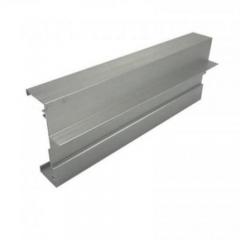
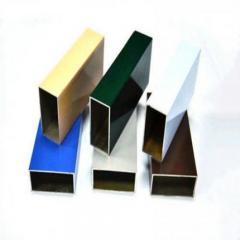
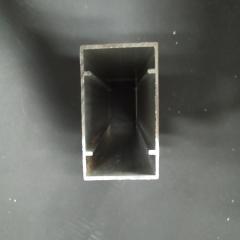
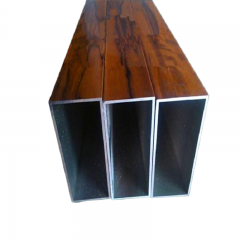
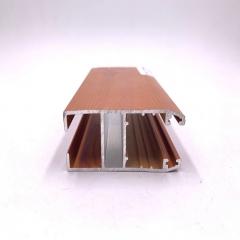
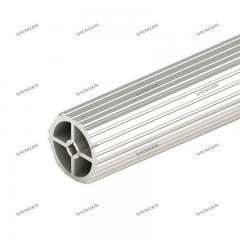
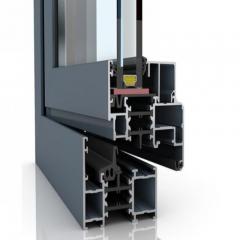
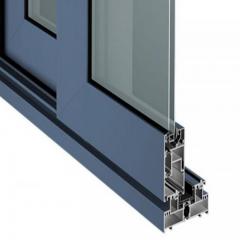
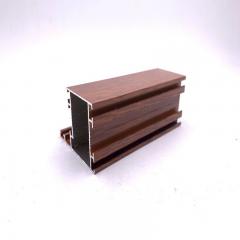
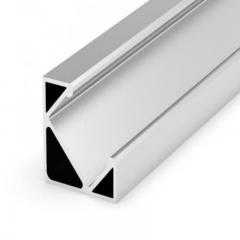
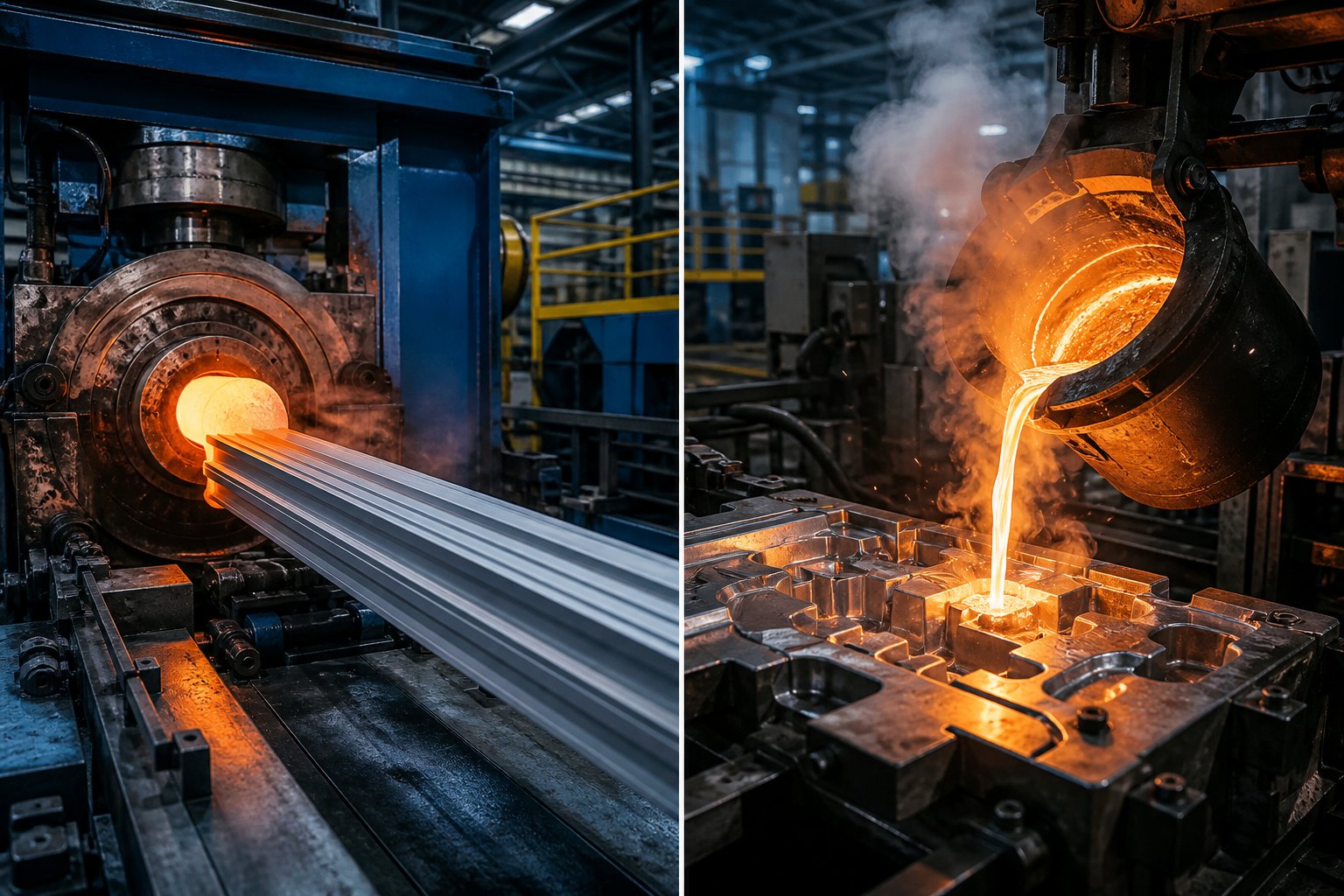
So, what is extruded aluminum? It's aluminum that has been pushed through a shaped die to create continuous profiles with consistent cross-sections - think window frames, structural beams, and heat sinks. What is cast aluminum? It's molten aluminum poured into molds to create complex three-dimensional shapes, from engine components to decorative hardware.
Understanding what is extrusions versus castings goes beyond basic definitions. Each method fundamentally affects your part's mechanical properties, dimensional accuracy, and cost structure. The wrong choice could mean a component that warps under stress, requires expensive secondary machining, or simply costs twice what it should.
Engineers and procurement managers often struggle with this decision because most resources only scratch the surface. You'll find plenty of definitions online, but actionable selection criteria? That's where the gap exists.
This guide changes that. Rather than leaving you with vague generalizations, we'll walk through the seven critical factors that actually determine which manufacturing method fits your specific situation:
By the end of this guide, you'll have a clear decision-making framework - not just theoretical knowledge, but practical criteria you can apply to your next project. Whether you're sourcing extruded aluminum profiles for architectural applications or evaluating cast aluminum for complex automotive parts, you'll know exactly which questions to ask and which factors matter most for your specific requirements.
Before diving into detailed comparisons, you need to understand how we're evaluating these two manufacturing approaches. Unlike vague overviews that leave you guessing, our methodology focuses on measurable, real-world factors that directly impact your project's success.
Our comparison framework draws from actual manufacturing requirements - the same criteria engineers use when specifying parts and procurement teams apply when evaluating suppliers. We didn't simply list theoretical advantages. Instead, we analyzed how each factor affects your bottom line, production timeline, and final product performance.
So, what does extruding mean in practical terms? The definition of extruding refers to forcing material through a shaped opening under pressure, creating continuous profiles with uniform cross-sections. This fundamental process difference from casting - where molten metal fills a mold cavity - creates distinct advantages and limitations that our evaluation captures.
Each criterion was weighted based on how frequently it becomes the deciding factor in real manufacturing decisions. We consulted industry standards, analyzed production data, and considered the full lifecycle costs that many comparison guides overlook.
Why these specific seven factors? Because they represent the complete picture of what determines manufacturing success. Miss any one of them, and you risk making a decision that looks good on paper but fails in practice.
Here's how we've prioritized the evaluation criteria, ranked by their typical impact on project outcomes:
This structured approach fills a gap you'll notice in competing resources - most offer definitions without decision frameworks. By understanding what is die cast aluminum capable of alongside extrusion capabilities across all seven factors, you'll have the complete picture needed for confident manufacturing decisions.
With our evaluation methodology established, let's examine the first and most critical factor: how each process affects your component's mechanical properties and structural performance.
When you're designing components that need to withstand real-world stresses, mechanical properties aren't just numbers on a spec sheet - they determine whether your part performs reliably or fails catastrophically. The manufacturing method you choose fundamentally shapes these properties, and understanding the differences between extruded and cast aluminum can save you from costly redesigns or field failures.
Is cast aluminum strong? The answer depends entirely on what you're comparing it to and what loads your application demands. Let's break down exactly how each process affects the mechanical characteristics you care about most.
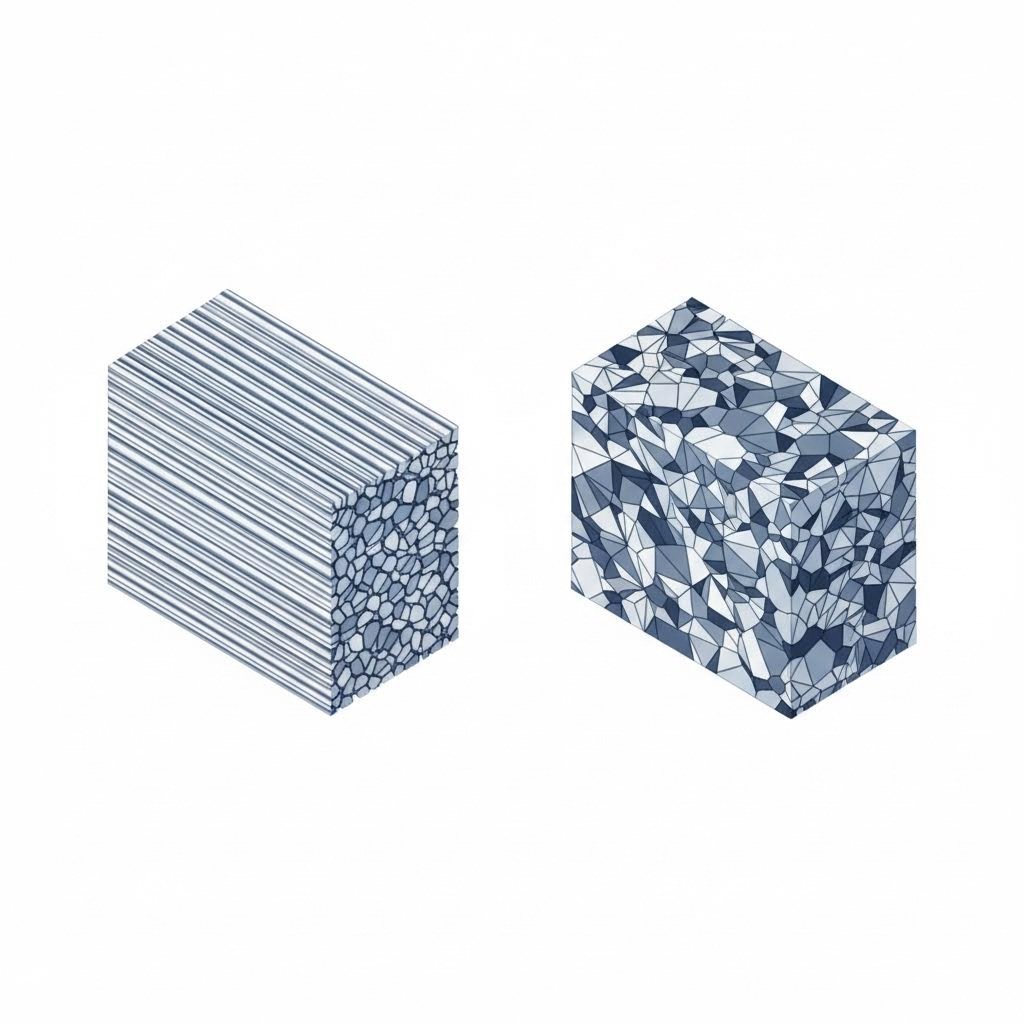
The extrusion process creates something remarkable at the microstructural level. When aluminum is forced through a die under immense pressure, the metal's grain structure aligns in the direction of extrusion. Think of it like aligning fibers in a rope - this directional orientation produces superior tensile strength along the profile's length.
Research published in the Journal of Materials Science and Engineering demonstrates this effect clearly. Extruded profiles from standard cast billets achieve tensile strengths around 165 MPa with yield strengths of 127 MPa. When using advanced billet preparation methods, these values increase to 178 MPa tensile and 144 MPa yield strength - representing a 10% improvement purely from grain refinement during extrusion.
Extruded structural aluminum benefits from what metallurgists call the Hall-Petch effect. Finer grain sizes - sometimes as small as 3 μm in optimized extrusions compared to 100 μm in cast materials - directly correlate with higher strength. The calculated strength contribution from this grain refinement accounts for approximately 17-19 MPa of additional yield strength.
Diecast aluminum, by contrast, develops an isotropic grain structure. The molten metal solidifies uniformly in all directions within the mold, creating consistent properties regardless of loading direction. While this isotropy can be advantageous for complex parts experiencing multi-directional stresses, it typically results in lower overall tensile strength compared to extruded profiles loaded along their primary axis.
Imagine a component that experiences millions of stress cycles over its lifetime - think suspension parts, structural frames, or vibrating equipment housings. Fatigue resistance becomes the critical property that determines service life.
Aluminum extruded through precision dies develops superior fatigue resistance for several reasons:
Cast aluminum faces inherent challenges with fatigue. The solidification process can trap gas bubbles, creating micro-voids that act as crack initiation sites. Additionally, variations in cooling rates across thick and thin sections produce inconsistent microstructures. However, die cast aluminum components can still achieve adequate fatigue performance when designed with appropriate safety factors and when porosity is controlled through vacuum-assisted casting or careful process parameters.
One particularly striking finding from materials research: extruded profiles can achieve elongation values 40% higher than cast equivalents while simultaneously delivering higher strength. This combination of strength and ductility translates directly to improved fatigue performance and greater resistance to sudden fracture.
When comparing cast aluminum vs aluminum extrusion for mechanical applications, each method brings distinct advantages to the table. Here's what you need to weigh:
| Property | Extruded Aluminum | Cast Aluminum |
|---|---|---|
| Tensile Strength | 165-280 MPa (alloy dependent) | 130-220 MPa (alloy dependent) |
| Yield Strength | 110-240 MPa | 90-180 MPa |
| Elongation | 8-15% | 2-8% |
| Hardness (Brinell) | 60-95 HB | 50-85 HB |
| Fatigue Resistance | Excellent (aligned grains) | Moderate (porosity concerns) |
| Property Uniformity | High consistency | Variable by section thickness |
The mechanical property comparison reveals a clear pattern: when your application demands maximum strength-to-weight ratio and fatigue resistance in a consistent cross-section, extrusion typically delivers superior results. When you need complex geometries with uniform properties in all loading directions, casting becomes the practical choice despite somewhat lower absolute strength values.
Understanding these mechanical trade-offs sets the foundation, but strength alone doesn't determine manufacturing success. Next, we'll examine how dimensional accuracy and surface finish quality differ between these methods - factors that often determine whether parts fit correctly and meet aesthetic requirements.
You've confirmed your component has the mechanical properties needed for your application. Now comes a question that catches many engineers off guard: can the manufacturing process actually deliver the precision your design requires? The difference between extruded metal profiles and die-cast aluminum parts in dimensional accuracy can mean the difference between parts that assemble perfectly and components that require costly rework.
Let's examine what tolerance levels you can realistically expect from each method - and when surface finish quality becomes the deciding factor.
When it comes to dimensional accuracy, the extrusion of aluminium holds a significant advantage. The process relies on precision-machined steel dies that maintain their shape under repeated use. As aluminum passes through these dies at controlled temperatures and pressures, it conforms precisely to the die geometry - delivering remarkably consistent cross-sectional dimensions.
Standard aluminum extrusion tolerances typically fall within ±0.1 to ±0.3 mm for most profile dimensions, with tighter tolerances achievable through precision extrusion processes. Wall thickness variations usually stay within ±0.15 mm, while straightness can be held to 0.5 mm per meter of length.
Cast aluminium tolerances tell a different story. The solidification process introduces variables that affect final dimensions:
Die-cast aluminum typically achieves tolerances of ±0.1 to ±0.5 mm depending on part size and complexity, with larger parts requiring wider tolerance bands. High-pressure die casting can achieve tighter tolerances than gravity or sand casting, but still generally falls short of what extrusion delivers for profile dimensions.
| Tolerance Factor | Aluminum Extrusion | Die-Cast Aluminum |
|---|---|---|
| Linear Dimensions | ±0.1 to ±0.3 mm | ±0.1 to ±0.5 mm |
| Wall Thickness | ±0.15 mm typical | ±0.25 to ±0.5 mm |
| Straightness | 0.5 mm per meter | N/A (3D shapes) |
| Flatness | 0.3 mm per 300 mm | 0.5 mm per 300 mm |
| Angular Tolerance | ±0.5° | ±1.0° |
| Secondary Machining Need | Minimal for most applications | Often required for mating surfaces |
Imagine running your finger along an aluminum component fresh from production. With extrusion, you'll feel a smooth, consistent surface that often requires no additional processing for many applications. Extruded profiles typically achieve surface roughness values of Ra 0.8 to 3.2 μm directly from the die.
This inherent surface quality makes extruded aluminum an excellent candidate for anodizing - the electrochemical process that creates a durable, corrosion-resistant oxide layer. The uniform surface accepts anodizing evenly, producing consistent color and protection across the entire profile. Similar principles apply to other manufacturing processes; for instance, extruded acrylic and extruded perspex sheet achieve their optical clarity precisely because the extrusion process creates smooth, uniform surfaces.
Cast aluminum surfaces present more complexity. According to Dynacast's surface finish guide, the casting process can produce surfaces ranging from acceptable for functional parts to requiring significant preparation for decorative finishes. Common surface treatments for castings include:
One notable development: advances in casting alloys like K-Alloy have enabled some raw castings to meet corrosion resistance requirements without additional surface treatment - potentially eliminating finishing costs entirely for certain applications.
Certain applications simply cannot compromise on dimensional accuracy. Understanding where each method excels helps you match the manufacturing process to your requirements.
Applications where extrusion tolerances typically suffice:
Applications where casting tolerances work well:
Here's the practical reality: when tight tolerances are non-negotiable, extrusion often delivers acceptable parts directly from the process, while casting frequently requires secondary machining operations. This distinction significantly impacts both cost and lead time - factors we'll examine in detail next.
The surface finish discussion also connects to a broader consideration. As Dynacast emphasizes, choosing appropriate surface treatment requires walking through a "discovery phase" that considers part design, functionality, and price factors. Getting your manufacturer involved early ensures the part design accounts for both the primary manufacturing process and any subsequent finishing requirements.
With dimensional accuracy and surface finish requirements clarified, the next critical question becomes: what will this actually cost? The economics of tooling, per-unit pricing, and hidden expenses often determine which manufacturing method makes financial sense for your specific production volumes.
Here's where most comparison guides fall short - they'll tell you extrusion is "cheaper" or casting is "more economical" without explaining when or why. The reality? Cost leadership shifts dramatically based on your production volume, part complexity, and how thoroughly you account for hidden expenses that don't appear on initial quotes.
Let's break down the actual economics that determine which manufacturing method delivers better value for your specific situation.
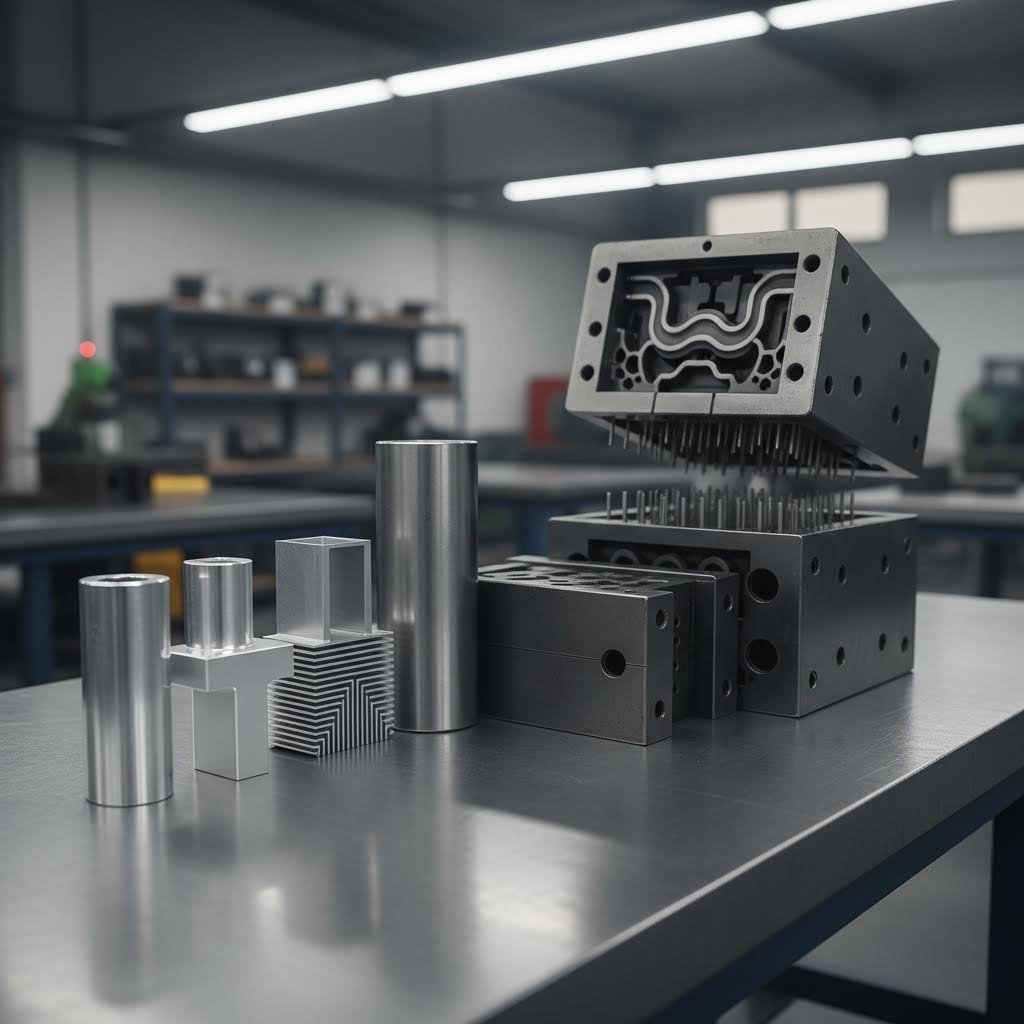
The upfront tooling investment often becomes the first decision filter - and this is where extrusion holds a significant advantage. According to American Douglas Metals, while casting tools can exceed $30,000, custom extrusion dies often cost under $1,000. That's a difference that fundamentally changes project economics.
Why such a dramatic gap? Extrusion dies are relatively simple steel tools that shape aluminum as it passes through. Die casting aluminum requires complex multi-piece steel molds engineered to withstand repeated thermal cycling, high injection pressures, and the erosive effects of molten metal. These aluminum metal casting molds demand precision machining, heat treatment, and often incorporate cooling channels and ejection mechanisms.
Industry data from HTS Aluminum provides more granular detail on this tooling comparison:
| Tooling Factor | Aluminum Extrusion | Aluminum Die Casting |
|---|---|---|
| Die/Mold Cost Range | $700 - $42,000 per set | $7,000 - $700,000+ per set |
| Lead Time for Tooling | 2-4 weeks typical | 8-16 weeks typical |
| Minimum Economic Batch | 1-10 tons | >1,000 pieces |
| Tool Life Expectancy | High (solid steel dies) | Limited (thermal cycling wear) |
| Modification Flexibility | Moderate - die adjustment possible | Low - often requires new mold |
The amortization patterns differ significantly too. Extrusion dies can often be proven and producing quality parts within weeks, allowing you to spread that modest investment across production almost immediately. Casting molds require months of development and validation before production begins - meaning your capital sits idle longer before generating returns.
Operations like a western extrusion aluminum casting house might offer both processes, but the tooling economics remain fundamentally different regardless of who manufactures your parts.
Tooling is just the entry fee. The real economic question is: what does each part actually cost at your production volume?
Raw material costs constitute approximately 90% of basic extrusion expenses, meaning material utilization becomes a critical cost driver. Here's where the processes diverge significantly:
| Cost Factor | Low Volume (100-1,000 pcs) | Medium Volume (1,000-10,000 pcs) | High Volume (10,000+ pcs) |
|---|---|---|---|
| Extrusion Tooling Amortized | $1-10 per part | $0.10-1.00 per part | $0.01-0.10 per part |
| Die Casting Tooling Amortized | $70-700 per part | $7-70 per part | $0.70-7.00 per part |
| Extrusion Material Utilization | 85-92% (minimal waste) | ||
| Die Casting Material Utilization | 60-80% (gates, runners, flash) | ||
| Extrusion Energy Cost | ~$80 per ton processed | ||
| Die Casting Energy Cost | ~$120 per ton processed | ||
Notice the crossover pattern. At low volumes, extrusion's modest tooling investment spreads across fewer parts but still results in reasonable per-unit costs. Die casting's high tooling cost makes low-volume production economically painful. As volumes increase, casting's per-unit tooling burden decreases - but it never completely overcomes extrusion's material efficiency advantage for comparable parts.
The material utilization difference deserves emphasis. When extrusion achieves 85-92% material utilization versus casting's 60-80%, you're paying for 10-30% more raw aluminum with every casting order. For aluminum extrusion with iron content alloys or premium materials, this waste percentage directly multiplies your material costs.
The quoted price rarely tells the complete story. Experienced procurement managers know to look beyond the per-piece price to capture total landed cost. Here are the hidden factors that frequently surprise buyers:
Energy consumption also factors into total cost calculations. Extrusion processes consume approximately 800-1,200 kWh per ton of aluminum processed, while die casting operations typically require 1,000-1,500 kWh per ton. This 25-40% energy premium for casting compounds over high-volume production runs.
When calculating true manufacturing costs, the visible per-piece quote often represents only 60-70% of your actual total cost. Factor in secondary operations, scrap recovery, quality assurance, and inventory carrying costs to understand real economic impact.
The environmental dimension connects to economics as well. Extrusion produces about 1.2-1.8 tons of CO2 per ton of aluminum versus 1.8-2.5 tons for die casting. As carbon pricing mechanisms expand globally, this emissions differential may increasingly translate to direct cost implications.
Understanding these cost dynamics positions you to make informed decisions - but economics alone shouldn't drive manufacturing method selection. The next critical factor to examine is how production volume requirements and scalability needs affect which process delivers optimal value at each stage of your product lifecycle.
You've crunched the numbers on tooling and per-unit costs. Now comes the question that ties everything together: at what production volume does each manufacturing method actually make economic sense? The answer isn't as straightforward as "extrusion for high volume, casting for low volume" - though that oversimplification appears in countless comparison guides.
The reality involves understanding how extruded aluminum is made versus how casting operates, and recognizing that volume thresholds shift based on part complexity, lead time requirements, and your production scaling strategy.
Imagine you're developing a new product. You need a handful of parts to validate your design, then a pilot run for testing, and eventually full-scale production. How each manufacturing method handles these transitions dramatically affects your project timeline and budget.
For aluminum extrusion products, the prototyping phase presents an interesting dynamic. Creating a new extrusion die typically takes 2-4 weeks, and once that die exists, producing prototype quantities is relatively fast and inexpensive. According to KMC Aluminium, three primary factors influence production lead time: tooling lead time for die creation, the actual extrusion lead time based on production scheduling, and fabrication lead time for any secondary operations.
The prototype-to-production transition for extrusion flows smoothly because the same die used for samples produces your full-volume orders. There's no retooling, no process changes, and minimal validation requirements between stages.
Casting prototypes follow a different path. As detailed by XTJ-CNC's prototyping guide, prototype aluminum casting leverages temporary or soft tooling - think sand molds, 3D-printed patterns, or machined dies - to produce parts quickly for design validation. This approach offers flexibility for early-stage testing but creates a significant transition gap.
When moving from prototype to production casting, you typically face:
So when does each method become the economically superior choice? The crossover points depend on your specific circumstances, but clear patterns emerge across typical manufacturing scenarios.
| Production Stage | Aluminum Extrusion | Aluminum Casting |
|---|---|---|
| Prototype (1-50 pcs) | Viable with new die investment; 2-4 week die lead time | Ideal with soft tooling; rapid pattern creation possible |
| Pilot Run (50-500 pcs) | Excellent - same die as prototype; minimal incremental cost | Challenging - soft tooling wearing; production tooling not yet justified |
| Low Volume (500-5,000 pcs) | Strong economics; tooling fully amortized | Marginal - high tooling cost spread across few parts |
| Medium Volume (5,000-50,000 pcs) | Optimal for extruded aluminum shapes and profiles | Becoming competitive for complex 3D geometries |
| High Volume (50,000+ pcs) | Excellent for consistent cross-sections | Optimal for complex parts; tooling fully leveraged |
The extruded aluminum process shines in what manufacturers call the "mid-volume sweet spot" - quantities from 1,000 to 50,000 pieces where tooling costs are easily absorbed but production efficiency matters. For continuous profiles and consistent cross-sections, extrusion maintains cost advantages even at very high volumes because material utilization stays superior to casting.
Casting economics improve dramatically above 10,000 pieces, but primarily for parts that genuinely require casting's geometric capabilities. If your part could be made either way, extrusion typically maintains the cost advantage across most volume ranges.
Beyond the initial volume decision, consider how each method handles production scaling as your demand grows or fluctuates.
Understanding how extruded aluminum is made reveals why scaling works so well with this process. The continuous nature of extrusion - pushing aluminum through a die to create long profiles that are then cut to length - means production rate scales almost linearly with press time. Need twice the volume? Run the press twice as long. Seasonal demand spikes? Schedule additional shifts. This flexibility proves invaluable for products with variable demand patterns.
Minimum order quantities also affect scaling decisions. KMC Aluminium explains that MOQs exist for sound economic and technical reasons: overhead costs for die preparation, press setup time, and quality checks all factor into minimum viable production runs. However, extrusion MOQs typically start at 1-10 tons depending on profile complexity - far more accessible than casting minimums for comparable parts.
Decision criteria at different production scales:
Lead time differences compound as volumes scale. Extrusion's shorter tooling lead time (2-4 weeks versus 8-16 weeks for casting molds) means faster market entry and more responsive production adjustments. When market conditions shift, extrusion operations can adapt die designs and resume production weeks before a casting operation completes mold modifications.
The most expensive manufacturing decision isn't choosing the wrong process - it's choosing the right process for the wrong volume. Match your production method to realistic demand projections, not optimistic forecasts that may never materialize.
With production volume economics clarified, the next critical factor becomes matching the right aluminum alloy to your chosen manufacturing method - because not all alloys work equally well for extrusion and casting applications.
You've determined your production volume and understood the cost implications. Now comes a decision that directly impacts your component's performance, appearance, and longevity: which aluminum alloy should you specify? The answer depends heavily on whether you're extruding or casting - because not every alloy works well with both manufacturing methods.
Think of it this way: choosing the right extruded aluminum alloy or aluminium casting material is like selecting the right ingredient for a recipe. The manufacturing process is your cooking method, and some ingredients simply perform better with certain techniques.
When engineers specify extruded aluminum, two alloy families dominate the conversation: 6063 and 6061. But understanding what is billet aluminium - the starting material for extrusion - helps explain why these alloys work so well.
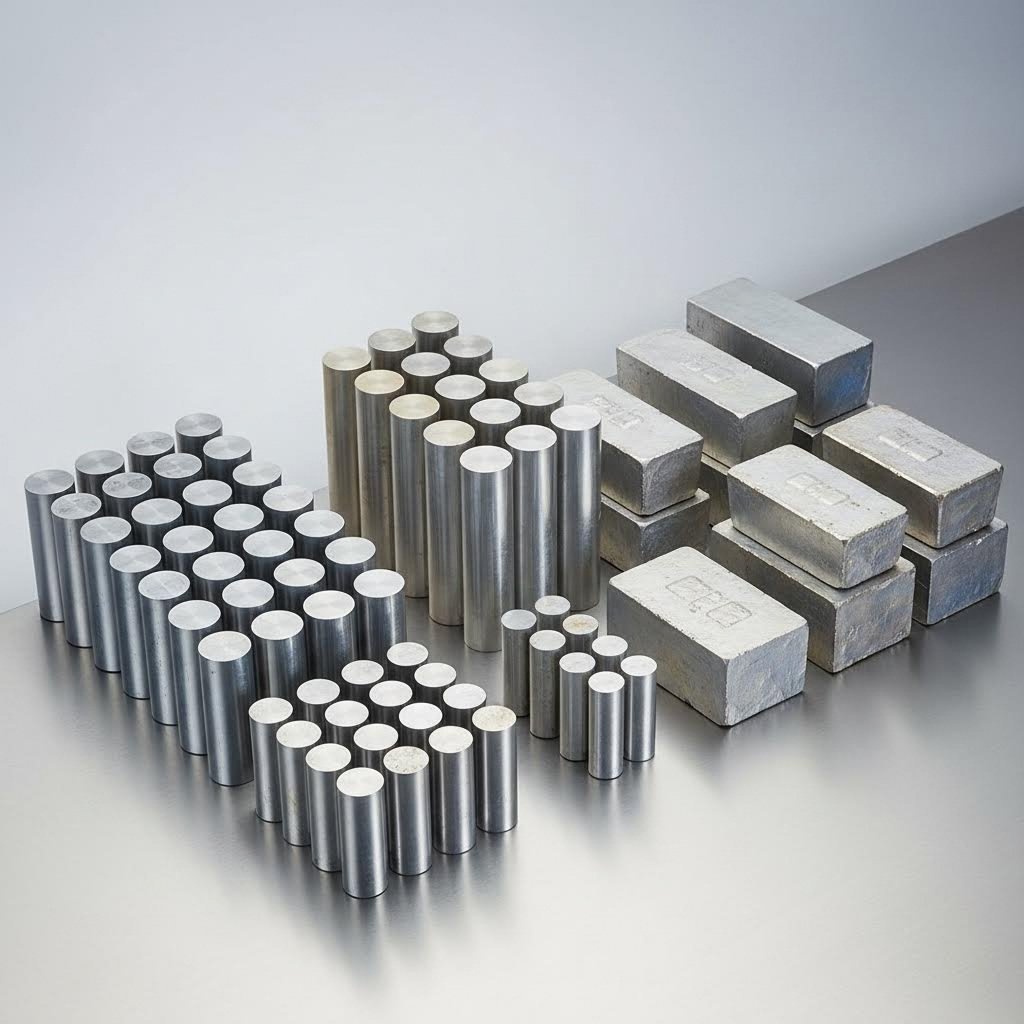
Billet aluminum is a solid cylindrical log of aluminum alloy, heated and pushed through a die to create profiles. For this process to work efficiently, the alloy must flow smoothly under pressure while maintaining structural integrity. The 6000 series alloys excel precisely because their magnesium and silicon content creates ideal flow characteristics.
6063 Aluminum - Often called "architectural aluminum," this alloy represents the most commonly extruded aluminum worldwide. Its balanced composition delivers:
6061 Aluminum - When higher strength matters more than surface finish, 6061 becomes the go-to choice. This alloy offers:
Other extrusion alloys serve specialized needs. The 7000 series (like 7075) provides aerospace-grade strength but sacrifices extrudability. The 5000 series offers superior marine corrosion resistance but limited heat treatability. For most industrial and architectural applications, however, 6063 and 6061 cover 90% of requirements.
Die cast aluminium alloys face different demands than extrusion materials. Molten aluminum must flow into complex mold cavities, solidify without excessive shrinkage, and release cleanly from the die. This requires carefully balanced compositions optimized for fluidity and casting behavior.
According to KenWalt's alloy guide, three alloys dominate aluminium die cast applications: A380, A356, and ADC12. Each brings distinct advantages depending on your application requirements.
A380 Aluminum - The most widely used die casting alloy in North America, A380 contains approximately 7.5-9.5% silicon and 3-4% copper. This composition delivers:
A356 Aluminum - When corrosion resistance matters, A356 outperforms higher-copper alloys. With 6.5-7.5% silicon and very low copper content, A356 provides:
ADC12 Aluminum - Popular in Asian manufacturing, ADC12 (similar to A383 in some standards) contains 9.6-12% silicon with moderate copper. KenWalt notes that this alloy offers a balance: better corrosion resistance than A380 due to lower copper, with excellent fluidity for complex geometries.
How do you choose between these options? Start with your application's non-negotiable requirements, then work backward to identify compatible alloys.
| Alloy | Manufacturing Method | Tensile Strength | Corrosion Resistance | Best Applications |
|---|---|---|---|---|
| 6063-T6 | Extrusion | 205-240 MPa | Excellent | Window frames, architectural trim, heat sinks |
| 6061-T6 | Extrusion | 270-310 MPa | Very Good | Structural framing, machine components, automotive |
| A380 | Die Casting | 320-380 MPa | Moderate | Engine brackets, housings, industrial components |
| A356-T6 | Die Casting | 230-280 MPa | Excellent | Wheels, marine parts, aerospace components |
| ADC12 | Die Casting | 280-330 MPa | Good | Electronic housings, automotive parts, complex geometries |
Selection criteria based on your application requirements:
Surface treatment compatibility also influences alloy selection. Extrusion alloys generally accept anodizing, powder coating, and painting with minimal preparation. Casting alloys may require more extensive surface prep - as KenWalt notes, "preparation of the surface is crucial" for ADC12 when applying finishes like anodizing or chem film.
One final consideration: your manufacturer's experience with specific alloys matters. Established extrusion operations know how to optimize press parameters for 6063 versus 6061, maximizing quality while minimizing defects. Similarly, experienced die casters understand the subtle process adjustments needed when switching between A380 and A356.
With alloy selection clarified, the next step involves understanding which industries favor each manufacturing method - and discovering how real-world applications inform the extrusion versus casting decision.

You've analyzed the mechanical properties, cost factors, and alloy options. Now comes the practical question that ties theory to reality: which industries actually use each manufacturing method, and why do they make those choices? Understanding real-world application patterns helps you benchmark your decision against proven industry practices.
What is an aluminum extrusion in practice? It's the window frame you see in commercial buildings, the heat sink cooling your electronics, and the structural frame supporting industrial equipment. Cast aluminum, meanwhile, shows up as engine components, complex housings, and decorative hardware. Let's explore why each industry gravitates toward specific manufacturing methods.
Walk through any modern commercial building, and you're surrounded by extruded aluminum. The construction industry overwhelmingly favors extrusion for one compelling reason: the process excels at producing long, consistent profiles that span windows, doorways, and curtain wall systems.
Consider what architects and builders need from aluminum components:
The extruded aluminum frame dominates construction applications because the process naturally produces exactly what builders need: long profiles with uniform cross-sections, excellent surface quality for anodizing or powder coating, and tight tolerances that ensure components fit together precisely.
Architectural applications also benefit enormously from experienced extrusion partners offering comprehensive surface treatment options. Window frames and industrial profiles require durable finishes that withstand decades of weather exposure - capabilities like anodizing in custom colors, powder coating for color matching, and PVDF coatings for extreme durability become essential rather than optional. Manufacturers like Shengxin Aluminium provide these end-to-end capabilities from die development through surface finishing, ensuring architectural projects receive profiles meeting both structural and aesthetic requirements.
Casting appears in construction primarily for decorative elements and complex hardware - door handles, ornamental brackets, and specialized fittings where three-dimensional geometry matters more than linear consistency.
The automotive industry presents a fascinating split: both extrusion and casting play critical roles, but for distinctly different components. Understanding this division reveals the practical logic behind manufacturing method selection.
According to Kinetic Die Casting, aluminum has revolutionized automotive manufacturing because it produces parts that are "sturdy and strong enough to withstand the load, and at the same time lightweight." Both processes contribute to vehicle lightweighting - but they solve different engineering challenges.
Where extrusion dominates in automotive:
Where casting excels in automotive:
The distinction becomes clear when you consider geometry. Steel extrusion principles don't translate directly to aluminum, but the same logic applies: extrusion works best for components with consistent cross-sections along their length. Casting handles everything else - the complex three-dimensional parts where internal cavities, variable wall thicknesses, and integrated features provide functional advantages.
When electronic components generate heat, aluminum dissipates it. This simple principle drives extensive use of both manufacturing methods in the electronics industry - though extrusion holds a commanding lead for thermal management applications.
Heat sinks represent perhaps the most iconic application of extruded aluminum in electronics. The process creates intricate fin geometries that maximize surface area for heat dissipation while maintaining precise dimensional control. A single extrusion die can produce complex fin patterns that would require extensive machining if manufactured any other way.
The cast aluminum heating board market addresses applications where extruded profiles cannot provide adequate thermal performance. Complex three-dimensional heat spreaders, components with embedded heat pipes, and integrated assemblies combining multiple functions often require casting's geometric flexibility.
Electronic enclosures demonstrate both methods in action. Simple rectangular enclosures often use extruded profiles for the main housing, with cast aluminum end caps providing cable entry points and mounting features. This hybrid approach leverages each method's strengths while minimizing overall component cost.
Companies like Benada Aluminum Products LLC and similar manufacturers serve this market by understanding when to recommend extrusion versus casting based on thermal requirements, production volumes, and cost constraints.
Manufacturing floors, processing plants, and industrial facilities rely on aluminum components that must withstand demanding environments while keeping costs manageable. Both manufacturing methods find extensive application here, though the decision criteria differ from consumer products.
| Industry | Typical Extrusion Applications | Typical Casting Applications | Primary Selection Criteria |
|---|---|---|---|
| Construction | Window frames, curtain walls, structural framing, railings | Decorative hardware, complex fittings, door handles | Profile consistency, surface finish, long-span capability |
| Automotive | Crash structures, body members, EV battery frames, trim | Engine blocks, transmission housings, suspension parts | Geometry complexity, internal features, integration level |
| Electronics | Heat sinks, enclosure profiles, rack components | Complex housings, thermal spreaders, integrated assemblies | Thermal performance, fin geometry, feature integration |
| Industrial Equipment | Machine frames, conveyor structures, guarding systems | Pump housings, valve bodies, motor mounts | Structural efficiency, pressure containment, wear resistance |
| Aerospace | Structural stringers, seat tracks, cargo rails | Actuator housings, complex brackets, landing gear parts | Weight optimization, fatigue resistance, certification requirements |
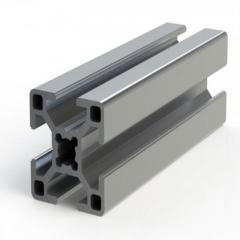
Industrial framing systems showcase extrusion's versatility. T-slot aluminum profiles form the backbone of machine guards, workstation frames, and automation equipment. The modular nature of these systems - where standard profiles connect with standardized hardware - demonstrates why consistent cross-sections and tight tolerances matter for industrial applications.
Fluid handling components often require casting. Pump housings with complex internal flow passages, valve bodies with multiple ports, and manifolds integrating numerous connections all demand casting's ability to create enclosed cavities and three-dimensional geometry.
The cast film extrusion process used in packaging represents an interesting crossover - here "extrusion" refers to polymer processing rather than metal forming, but aluminum dies and components often support these production lines. This illustrates how manufacturing industries interconnect, with aluminum components from both extrusion and casting supporting diverse production processes.
Industry application patterns reveal a consistent principle: extrusion dominates when consistent cross-sections, surface quality, and linear profiles matter most. Casting wins when complex three-dimensional geometry, integrated features, or internal cavities become essential design requirements.
Understanding how different industries apply these manufacturing methods provides valuable benchmarking for your own decisions. With this industry context established, the next section brings everything together in a comprehensive comparison matrix that summarizes all seven evaluation factors at a glance.
You've examined each factor individually - mechanical properties, tolerances, costs, volumes, alloys, and industry applications. Now it's time to see the complete picture in one place. This decision matrix distills everything into a practical reference you can use when evaluating your next aluminum component project.
Understanding what is extruded versus cast aluminum at a deep level requires synthesizing multiple factors simultaneously. The matrix below captures how aluminum vs cast aluminum alternatives stack up across every criterion that matters.
When comparing cast aluminum versus aluminum extrusion, the differences become clear once you see all seven evaluation criteria side by side. This comprehensive table summarizes the key distinctions covered throughout this guide:
| Evaluation Factor | Aluminum Extrusion | Die Casting Aluminium | Winner By Application |
|---|---|---|---|
| Mechanical Properties | Tensile strength 165-280 MPa; aligned grain structure; superior fatigue resistance; elongation 8-15% | Tensile strength 130-220 MPa; isotropic properties; potential porosity concerns; elongation 2-8% | Extrusion for strength-critical linear parts; Casting for multi-directional loading |
| Dimensional Tolerances | ±0.1 to ±0.3 mm linear; ±0.15 mm wall thickness; 0.5 mm/m straightness | ±0.1 to ±0.5 mm linear; ±0.25 to ±0.5 mm wall thickness; variable by section | Extrusion for precision assemblies; Casting acceptable for non-critical fits |
| Cost Factors | Tooling $700-$42,000; 85-92% material utilization; minimal secondary machining | Tooling $7,000-$700,000+; 60-80% material utilization; often requires machining | Extrusion for most volumes; Casting only at very high volumes for complex parts |
| Production Volume | Economic from 1-10 tons; scales linearly; 2-4 week tooling lead time | Economic above 10,000+ pieces; requires 8-16 week tooling development | Extrusion for low-to-medium volumes; Casting for high-volume complex parts |
| Design Complexity | Limited to consistent cross-sections; hollow sections possible; no internal cavities | Complex 3D geometries; internal passages; variable wall thicknesses; integrated features | Extrusion for profiles; Casting for three-dimensional complexity |
| Surface Finish | Ra 0.8-3.2 μm as-extruded; excellent anodizing response; minimal prep required | Variable by process; may require prep for finishing; some alloys challenge anodizing | Extrusion for decorative and architectural; Casting for functional surfaces |
| Lead Times | Die creation 2-4 weeks; same die for prototype through production | Prototype tooling fast; production molds 8-16 weeks; retooling between stages | Extrusion for faster market entry; Casting when development time available |
The cast aluminium vs aluminium extrusion comparison reveals distinct patterns. Neither process universally dominates - the right choice depends entirely on matching manufacturing capabilities to your specific requirements.
Beyond the detailed comparison, you need clear decision triggers - specific situations where one method clearly outperforms the other. Use this quick reference when evaluating your project requirements.
The fundamental decision rule: Choose extrusion when your part can be defined by a single cross-section extended along a length. Choose casting when your part requires three-dimensional complexity that cannot be achieved through a uniform profile.
When to Choose Aluminum Extrusion:
When to Choose Aluminum Casting:
The aluminum versus cast aluminum decision often comes down to geometry first, economics second. A part that could be made either way typically favors extrusion due to lower tooling costs and better material efficiency. Only when casting's geometric capabilities provide genuine functional advantages - or when volumes are extremely high - does casting become the economically superior choice.
Consider this practical test: sketch your component in cross-section. If that single cross-section, extended along a straight or curved path, defines your complete part geometry, extrusion likely offers the best value. If you need to sketch multiple views to capture internal features, varying sections, or three-dimensional complexity, casting deserves serious consideration.
This decision framework addresses what most competitor resources leave unanswered - not just what each process can do, but when each process makes sense for real-world manufacturing decisions. With this complete comparison in hand, you're ready to make a confident choice for your specific application.
You've worked through the complete comparison - mechanical properties, tolerances, costs, volumes, alloys, and industry applications. Now comes the moment of truth: applying everything you've learned to your specific project. The right decision isn't about which process is "better" in abstract terms. It's about which manufacturing method delivers optimal results for your unique requirements.
So what is extrusion aluminum in practical terms for your project? It's the manufacturing pathway that makes sense when your component geometry, budget constraints, and performance requirements align with extrusion's core strengths. Let's crystallize the decision criteria into actionable recommendations you can apply immediately.
After analyzing all seven evaluation factors, clear patterns emerge that should guide your manufacturing method selection. Use these scenario-based recommendations to match your project characteristics with the optimal process.
Choose aluminum extrusion when your project matches these criteria:
Choose aluminum casting when your project matches these criteria:
The most successful manufacturing decisions start with geometry and end with economics. If your part can be defined by a single cross-section extended along a length, extrusion almost always delivers better value. Only when casting's three-dimensional capabilities provide irreplaceable functional advantages - or when volumes reach truly massive scale - does casting become the superior choice.
Deciding between extrusion and casting is just the beginning. Executing that decision successfully requires partnering with manufacturers who understand your requirements and can deliver consistent quality at competitive pricing.
For projects moving forward with extrusion, your manufacturer selection becomes critical. According to Inquivix Technologies, the right supplier affects everything from product design through manufacturing quality and final cost. Key capabilities to evaluate include:
Manufacturers offering end-to-end support from die development through mass production - like Shengxin Aluminium with their 30+ years of industry expertise and 35 advanced extrusion presses - streamline your supply chain while maintaining quality control across every production stage. This integrated approach proves especially valuable for custom aluminum solutions requiring tight coordination between extrusion, machining, and finishing operations.
For casting projects, similar due diligence applies. Evaluate potential partners on their experience with your specific alloy requirements, their quality control systems for detecting porosity and dimensional issues, and their ability to scale from prototype tooling through production molds without requiring complete redesigns.
Regardless of which manufacturing method you select, successful projects share common elements:
The definition of extruded aluminum success ultimately comes down to matching process capabilities with project requirements - then executing that match through experienced manufacturing partners who understand your industry's specific demands. Armed with the decision framework from this guide, you're now equipped to make that match confidently and move your project from concept to production with clarity about the path ahead.
Yes, extruded aluminum is generally harder and stronger than die-cast aluminum. The extrusion process creates an aligned grain structure that delivers superior tensile strength (165-280 MPa versus 130-220 MPa for casting) and better fatigue resistance. Extruded profiles also achieve higher elongation values (8-15% versus 2-8%), providing improved ductility. However, cast aluminum offers isotropic properties with uniform strength in all directions, which can be advantageous for complex parts experiencing multi-directional stresses.
Casting involves pouring molten aluminum into molds to create complex three-dimensional shapes with internal cavities and variable wall thicknesses. Extrusion forces solid aluminum through a shaped die to produce continuous profiles with uniform cross-sections. Cast aluminum suits engine blocks, pump housings, and intricate brackets, while extruded aluminum excels for window frames, heat sinks, and structural beams. Extrusion offers tighter tolerances (±0.1-0.3mm) and smoother surfaces, while casting provides greater geometric flexibility.
Look for these key differences: extruded aluminum has a smoother, more uniform surface texture and maintains a consistent cross-section along its length. Cast aluminum typically displays a rougher, slightly grainy texture and features complex three-dimensional shapes with varying wall thicknesses. Examine the part geometry - if it could be defined by a single cross-section extended along a path, it's likely extruded. Parts with internal cavities, undercuts, or integrated mounting features are usually cast.
Extruded aluminum has three main limitations: anisotropic properties mean strength varies by loading direction, with maximum strength only along the extrusion axis. The process is limited to profiles with consistent cross-sections, preventing complex 3D geometries in a single operation. Additionally, parts requiring internal cavities, enclosed passages, or undercuts cannot be produced through extrusion alone and may need secondary machining or assembly with other components.
For volumes under 10,000 pieces, extrusion typically offers better economics due to lower tooling costs ($700-$42,000 versus $7,000-$700,000+ for casting molds) and higher material utilization (85-92% versus 60-80%). Extrusion becomes economical starting from just 1-10 tons with 2-4 week tooling lead times. Casting becomes competitive above 10,000-20,000 pieces for complex 3D parts, but only when the geometry genuinely requires casting's capabilities. For simple profiles at any volume, extrusion maintains cost advantages.



 dịch vụ trực tuyến
 0086 136 3563 2360
 sales@sxalu.com
 +86 136 3563 2360
 Việt
Việt English
 français
 Deutsch
 русский
 español
 português
 العربية
 ไทย
ไทย Українська