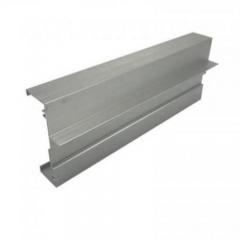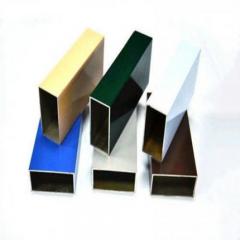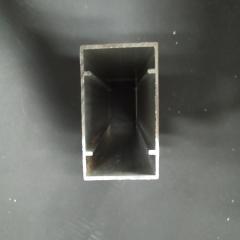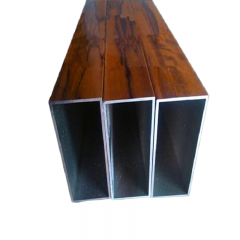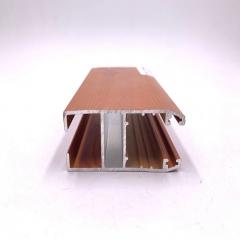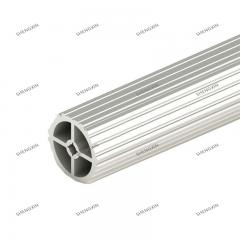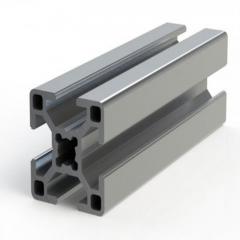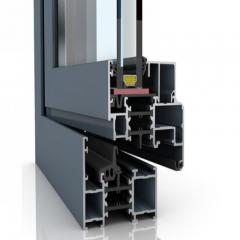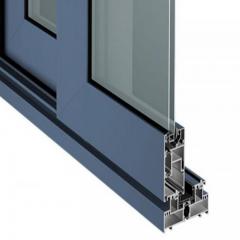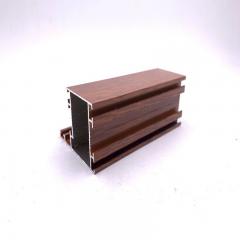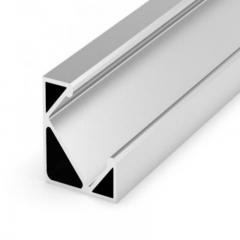
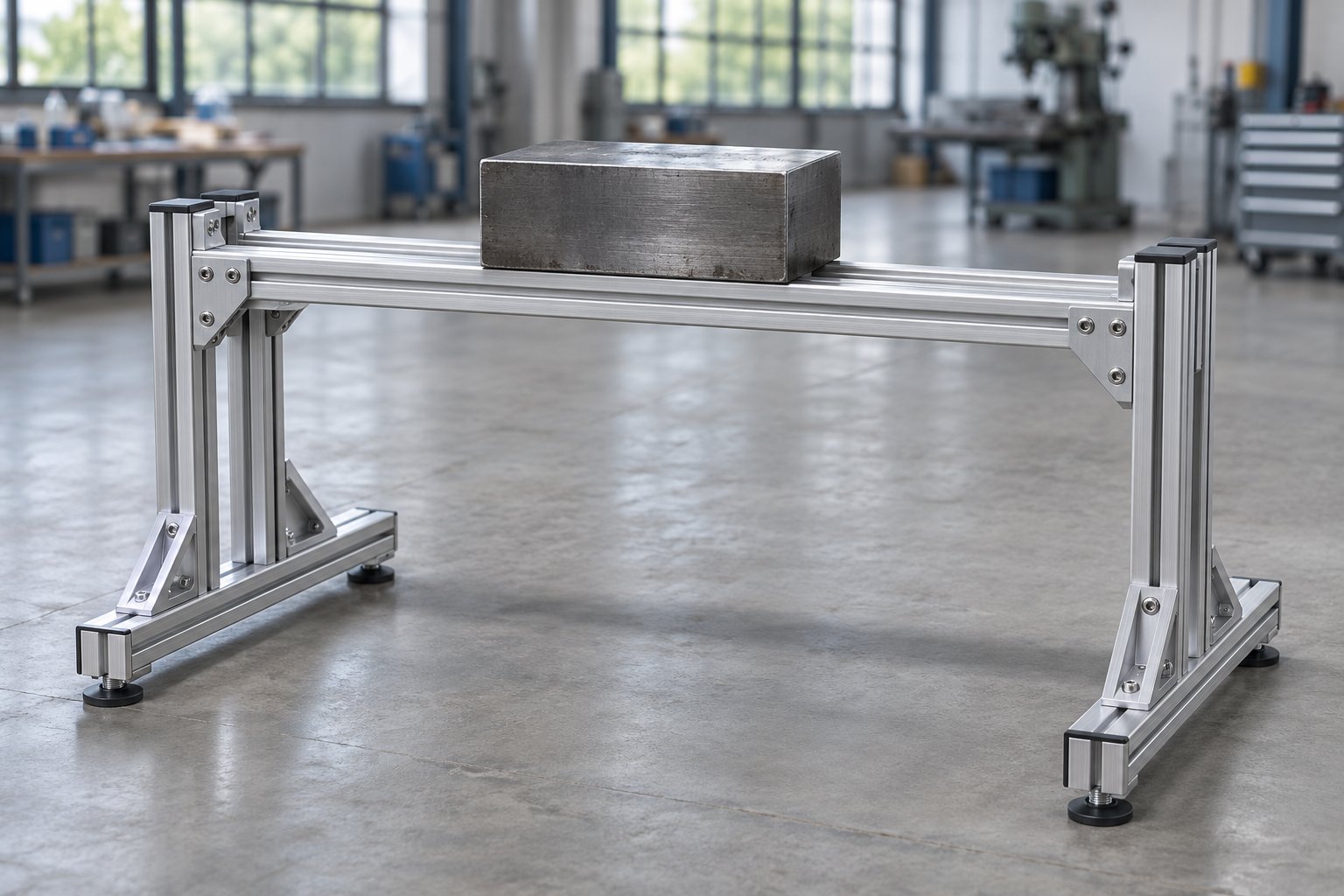
A t slot aluminium extrusion is an extruded aluminum profile with one or more T-shaped channels running along its length. Fasteners such as T-nuts slide into these channels, so frame members can be bolted together, adjusted, and taken apart without welding. The format is also called T-slot structural framing.
Wikipedia describes these profiles as square or rectangular lengths with the slot centered on one or more sides. It also lists generic names such as "aluminium profile" alongside brand names. Each length starts as a heated billet pushed through a shaped die, which gives it the same cross-section from one end to the other. Look at a cut end and you'll see four features:
Say you need to mount a sensor bracket on a frame upright. With t slot aluminum, the job takes four steps:
Nothing is welded or bonded, so the joint is held only by the clamping force of the bolt. Loosen the bolt and the bracket slides to a new spot, or it comes off to be reused on the next build. Most attachments need no drilling. Some hidden corner connectors do need a tapped center bore or an access hole, as the Phidgets T-slot guide shows. Choose a bolt long enough to engage the nut fully but short enough that it doesn't press into the aluminum behind the nut. A bolt that bottoms out like that leaves the mount with some play.
T-slot framing comes in two families, metric profiles sized in millimeters and fractional profiles sized in inches, and the next section explains how each family names its series.
Many international buyers spell the word "aluminium" when they search, and most of them work in metric. For that reason, this article covers metric series in the same depth as fractional ones. The coverage matters because no published standard defines the system. Manufacturers instead follow a set of conventional sizes, and the series names are the first place to see them.
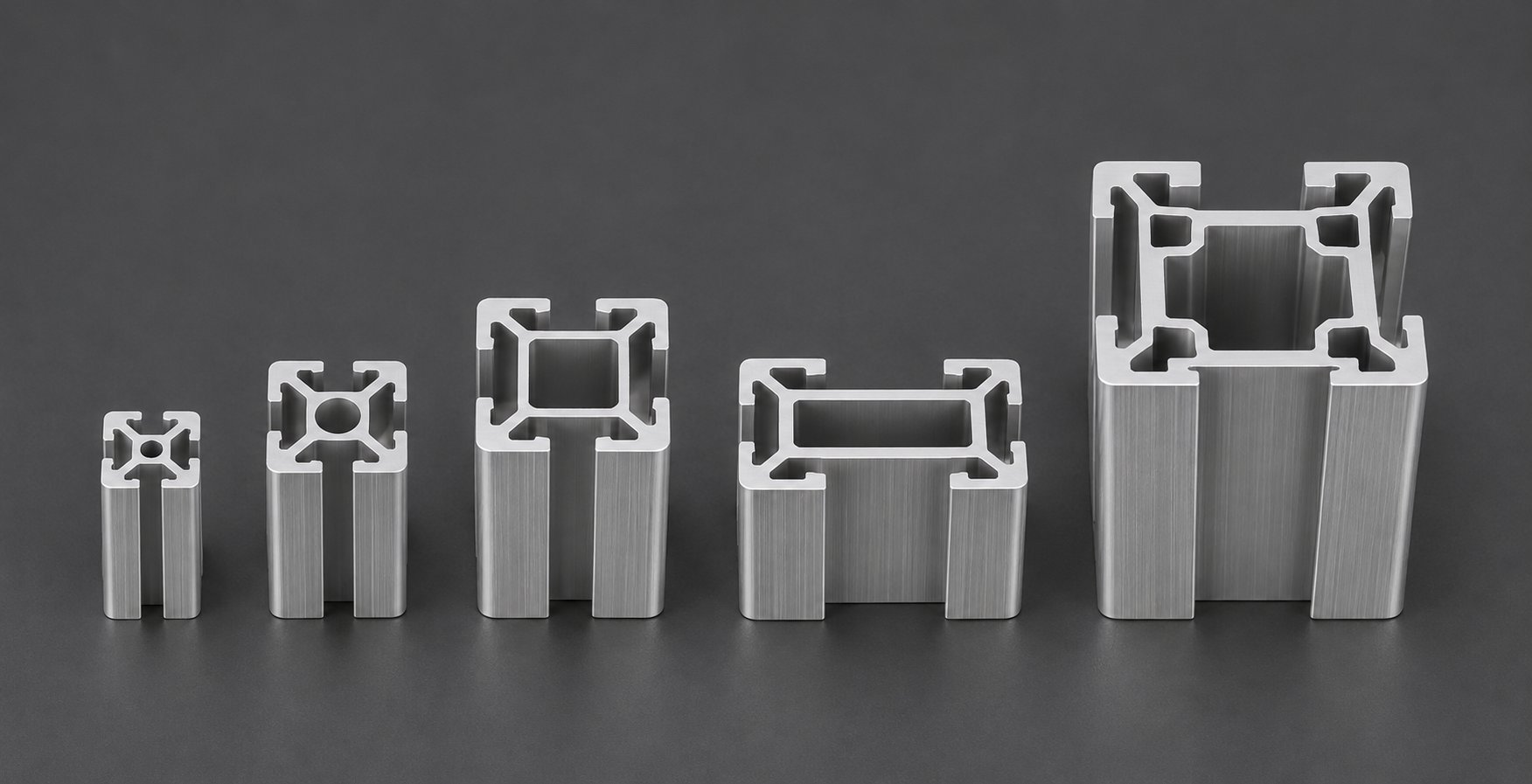
Have you ever read a catalogue line such as "20-2040" or "1530" and wondered which number is the size? Every part of the name means something. The 80/20 naming guide splits a profile name into three parts: a series number, a size or shape code, and optional suffixes for features such as a black anodized finish. The series number gives the base size that every profile in the family is built from. The size code after it usually gives width by height.
Each metric series takes its name from its base size in millimeters. A 20 Series profile is built on a 20 mm base, and the 30, 40 and 45 Series work the same way. In names such as 2020, 8040 and 8080, the digits give the cross-section as width by height in millimeters. A metric 8040 is 80 mm by 40 mm, and an 8080 is 80 mm square. The 2020 profile is the small square workhorse: 20 mm by 20 mm, with one slot on each face.
The 25 series extrusion fills the gap between 20 and 30. The 80/20 25 Series range includes the 25-2525, a 25 mm x 25 mm profile with four open T-slots, along with 25 mm x 50 mm, 25 mm x 75 mm and 50 mm x 50 mm sections. Metric names usually include the series prefix, as in 20-2020 or 30-3030. Watch for that prefix, because it is what tells a metric profile apart from a fractional one that uses the same digits.
If you searched "what is 10s 80 20 aluminum extrusion", the short answer is that 10 Series is the fractional family built on a 1 in base. The 80/20 15 Series is the family built on a 1.5 in base. Fractional names usually leave out the series prefix, so a 1010 is 1 in square, a 1020 is 1 in by 2 in, and a 1515 is 1.5 in square.
The same digits can describe very different parts. A 10 Series 2020 measures 2 in by 2 in and has two slots on each side, because it is two 1 in modules wide and two tall. A 20 Series 20-2020 measures 20 mm by 20 mm and has one slot per side. In the same way, a 15 Series 3030 is 3 in square, while a 30-3030 is 30 mm square.
| Series | System | Base size | Typical naming example |
|---|---|---|---|
| 20 Series | Metric | 20 mm | 20-2020 (20 x 20 mm), 20-2040 (20 x 40 mm) |
| 25 Series | Metric | 25 mm | 25-2525 (25 x 25 mm), 25-2550 (25 x 50 mm) |
| 30 Series | Metric | 30 mm | 30-3030 (30 x 30 mm) |
| 40 Series | Metric | 40 mm | 40-4040 (40 x 40 mm), 40-8040 (80 x 40 mm) |
| 45 Series | Metric | 45 mm | 45-4590 (45 x 90 mm) |
| 10 Series | Fractional | 1 in | 1010 (1 x 1 in), 1020 (1 x 2 in) |
| 15 Series | Fractional | 1.5 in | 1515 (1.5 x 1.5 in), 1530 (1.5 x 3 in) |
Suppliers keep large stocks of both families. The 80/20 profile catalogue lists 140 fractional and 131 metric profiles. With that many options in each system, availability won't decide the choice for you. Pick the system that fits your design and works with the hardware you plan to use.
How large is 25 mm next to a 1 in profile? One inch equals 25.4 mm, so 25 mm comes to about 0.984 in. Each face of a 25 Series profile is about 0.4 mm narrower than a 10 Series face. Side by side on a bench, you would have trouble telling them apart. The outside sizes match so closely that buyers get caught out. Each system's slots and threads were designed separately, and those features, not the outer face, decide whether a fastener seats.
Have you ever tightened a T-nut and felt it spin instead of lock? The slot width is usually the cause. A series name gives you the outside size of a profile. The slot width decides which hardware will hold in it.
Slot width controls which T-nuts and bolts fit, which panel edges and retainers seat in the opening, and how much contact area the nut has under the slot lips when you tighten it. Larger profiles tend to have wider slots, which take bigger threads and spread the clamping force over more aluminum. The Framing Tech compatibility chart shows this pattern across one manufacturer's range:
| Series | System | Slot width (one manufacturer's data) |
|---|---|---|
| 10 Series | Fractional | 0.26 in |
| 15 Series | Fractional | 0.32 in |
| 20 Series | Metric | 5 mm or 6 mm |
| 30 Series | Metric | 8 mm |
| 40 Series | Metric | 8 mm or 10 mm |
| 45 Series | Metric | 10 mm |
The 20 and 40 Series each come with two slot widths, even within this one catalogue. Other brands set their own slot widths, so the same nominal series can arrive with a different slot. Use the table as an example of the pattern only. Read the slot width from the data sheet of each profile you buy, because the series name does not tell you.
Slot width narrows down the hardware, and thread size settles the final choice. Some suppliers put both in the part number. Framing Tech labels a TN10M6 as a T-nut for its 10 mm slot with an M6 thread. The main fastener types do different jobs:
Fractional and metric fasteners and T-nuts do not interchange. Framing Tech tells buyers not to mix the two systems in one build. The 15 Series slot shows why. At 0.32 in, it works out to about 8.1 mm, which is close to a metric 8 mm slot. The lip thickness, cavity depth and nut shape were still designed separately for each system. Fractional hardware uses inch threads and metric hardware uses M threads, so a nut that slides into the slot still won't accept the other system's bolt. Parts can fail to fit within a single system too. Framing Tech notes that certain square nuts won't work with its 40 Series profiles that have the 10 mm slot.
Claims of compatibility across brands need the same caution. Among the major T-slot suppliers, TNUTZ is the only one that publishes a cross-brand equivalence, and it covers a single part. A label such as "80/20 compatible t-slotted framing system" is only useful after you have checked slot width, slot depth and thread size on both data sheets. Matching geometry still covers only part of the specification. Aluminum t slots with identical geometry can differ in alloy, temper and finish, and those properties decide how well the frame holds up in use.
Before you order any connector, confirm the slot width and thread standard on the data sheet for the exact profile it will mount to.
Two profiles from different suppliers can have the same slot and outside size and still perform differently once they are in service. The alloy, the temper and the anodized coating explain most of that difference. Product pages rarely give you much detail on any of them.
T-slot suppliers usually specify one of two alloys: 6105-T5, or 6063 in a T5 or T6 temper. Both alloys belong to the 6xxx family, which uses magnesium and silicon as its main alloying elements. The code after the dash is the temper, meaning the heat treatment that sets the final strength. Thomasnet lists 6063-T6 at a yield strength of 214 MPa (31,000 psi) and an ultimate tensile strength of 241 MPa (35,000 psi). Those figures apply to T6 only. Each temper has its own properties, so 6063-T5 values will be different.
6063 is often called "architectural aluminum." It extrudes well into complex shapes, gives a smooth surface, and resists corrosion well because it contains little copper. Framing makers generally choose 6105-T5 when they want more strength than 6063-T5 offers. If strength figures matter for your build, ask for the mill certificate or the manufacturer data sheet for the exact alloy and temper that will ship.
Choosing a stronger alloy has one limit. Thomasnet notes that 6xxx alloys behave almost the same elastically, so their modulus of elasticity is nearly identical. A stronger alloy can carry more load before it bends permanently. It won't reduce how far a beam sags under a given load.
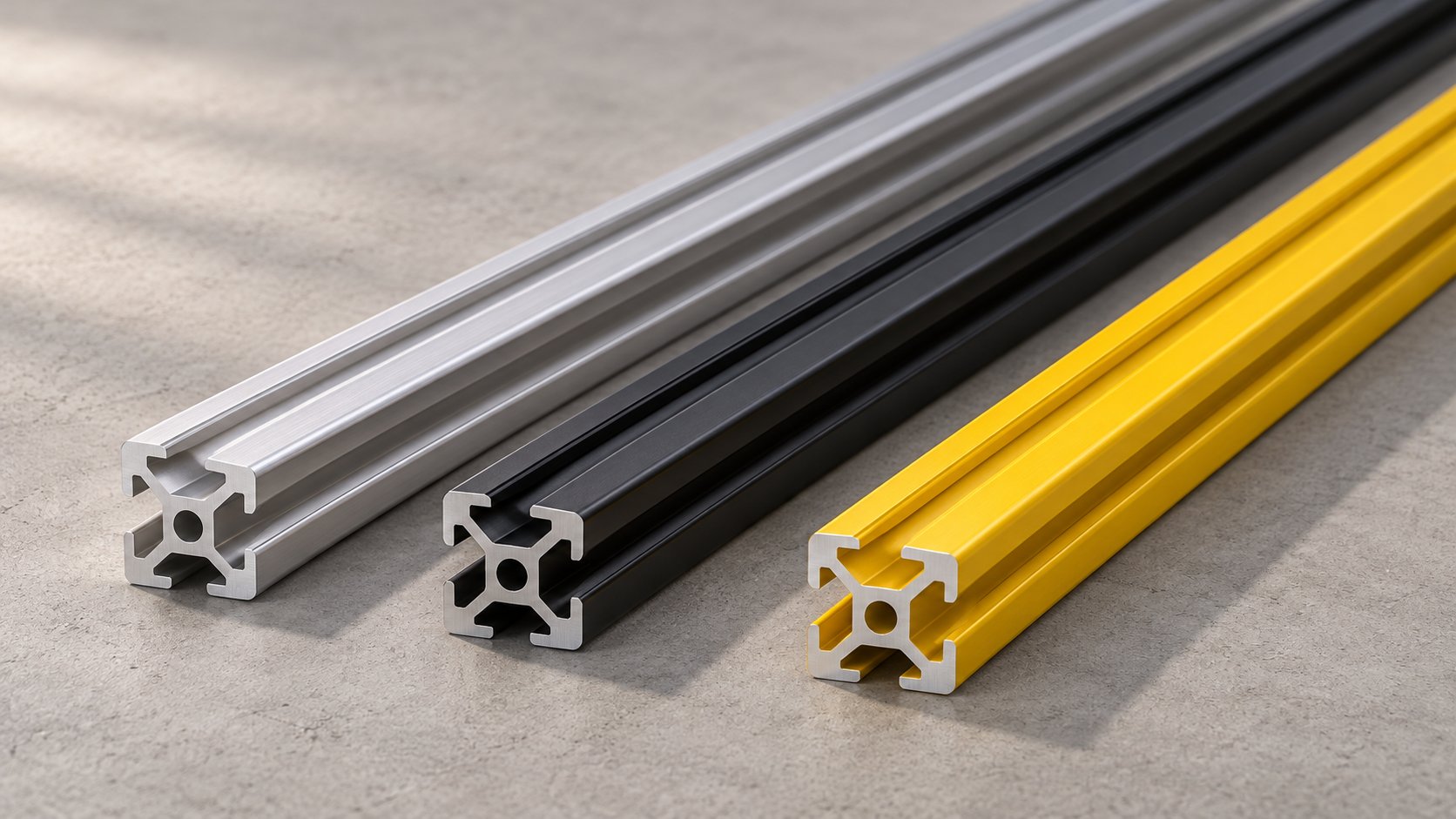
The 80/20 catalogue offers profiles in clear, black and yellow anodize. Yellow covers only a few profiles and is mostly used for safety guarding, which is also how Parco uses it. Anodizing grows a controlled aluminum oxide layer in an acid bath. That layer improves corrosion and wear resistance and also insulates the surface electrically. PFI explains that roughly half of the layer grows into the metal and half builds up above the surface.
The MIL-A-8625 specification defines three anodize types. Type II, the common sulfuric acid process, produces coatings from 0.0001 to 0.001 in thick (2 to 25 microns) and can be left clear or dyed. Type III hardcoat can reach 0.004 in and is much harder. Each type covers a range of thicknesses, so the type and the thickness together decide how well a finish holds up.
A vendor's claim that a finish is good for indoor and outdoor use only means something when the anodize spec is stated with it. For outdoor, washdown or high-humidity use, ask the supplier these questions:
| Finish | Typical use seen in catalogues | What to confirm with the supplier |
|---|---|---|
| Clear anodize | General frames, workstations, enclosures | Anodize type, thickness, sealing |
| Black anodize | Machine frames, optical and display builds | Thickness under the dye, fade resistance outdoors |
| Yellow anodize | Safety guarding and hazard marking | Availability by profile, thickness, sealing |
With the alloy and finish confirmed, you know what the profile is made of. How much a frame sags depends on how that material is distributed across the profile's cross-section, and the data sheet gives those figures.
Have you ever opened the spec block on a profile page and found a few numbers with no explanation? Take the standard 10 Series EX-1010, a 1 in square profile. TNUTZ publishes three figures for it: a weight of 0.548 lbs/ft, a cross-sectional area of 0.457 in2, and a moment of inertia of Ix = Iy = 0.046 in4. Each figure answers a different design question.
| Property | EX-1010 value | What it tells you | Where it is used in design |
|---|---|---|---|
| Weight per foot | 0.548 lbs/ft | How much each foot of profile weighs | Frame weight, freight cost, whether the frame can be moved by hand or needs casters |
| Cross-sectional area | 0.457 in2 | How much aluminum is in each slice of the profile | Axial tension and compression checks, material cost |
| Moment of inertia | Ix = Iy = 0.046 in4 | How well the profile resists bending, equal on both axes | Deflection calculations for beams, shelves and spans |
Weight per foot is the easiest figure to use. Multiply it by the total length in your cut list and you get the extrusion weight of the frame. That number sets the freight cost and tells you whether one person can lift the finished frame. A cart built from 40 ft of EX-1010 has about 21.9 lb of aluminum in it before you add brackets, panels or casters. Metric sheets give the same figure in kg/m, and 0.548 lbs/ft works out to about 0.82 kg/m.
Cross-sectional area is the amount of aluminum in one slice of the profile. The Vention rigidity guide ties area to how well a profile resists axial forces, meaning compression or tension along its length. Area also tracks weight and cost, so a larger area means more material to pay for. For a short leg carrying a load straight down, area is the figure to check. A long, slender column can buckle before the aluminum itself fails, and buckling depends on moment of inertia instead.
Moment of inertia, also called the second moment of area, describes how the material is spread around the axis the beam bends about. Material far from that axis adds much more stiffness than material near the center. That is why an aluminum extrusion profile puts most of its metal into the outer walls. A higher value means less sag under the same load. Data sheets list it in in4, or in mm4 or cm4 for metric profiles. The EX-1010 figure of 0.046 in4 is about 1.91 cm4.
The x and y labels refer to the two bending axes. A square profile with a slot on all four faces is symmetric, so Ix equals Iy and the profile bends the same amount whichever way you turn it. A square outline alone doesn't guarantee this. The TNUTZ EX-1010-C-BLACK is also 1 in square, but it has slots on only two opposite faces. Its sheet lists Ix = 0.046 in4 and Iy = 0.057 in4.
On rectangular profiles the difference between the axes gets much larger. An 8040 aluminum extrusion is twice as deep in one direction as in the other, so its two values are far apart. Vention's extrusion design guide lists its 45 x 90 mm profile at 1,111,757 mm4 on one axis and 287,967 mm4 on the other, a ratio of nearly 4 to 1. If the load pushes down on a rectangular beam, set the beam with its tall side vertical. Before you use the figure in a calculation, check which axis it refers to, because brands label the axes differently.
More detailed sheets add other fields, such as:
Use these values only when the manufacturer publishes them for the exact part number. Figures taken from a similar profile, or from another brand's profile with the same outside dimensions, may be wrong for the profile you actually buy.
A moment of inertia of 0.046 in4 still doesn't tell you how far a shelf beam will sag. The sag depends on how long the beam is, where the load sits, and how stiff the aluminum is. A deflection formula combines all three.
Imagine a 3 ft shelf beam that looks fine when it's empty. Then you set a 50 lb fixture in the middle and it visibly dips. Was the profile too small, or was the span too long? A beam deflection formula tells you before you cut anything.
The MechaniCalc beam deflection tables are drawn from standard texts such as Gere and Shigley. They give the maximum deflection for the three cases you'll meet most often in extruded aluminum framing:
In these formulas, δ is the deflection, P is the point load, w is the load per unit length, L is the span, E is the modulus of elasticity of the aluminum, and I is the moment of inertia about the bending axis. Keep the units consistent. If L is in inches and E is in psi, w must be in lb/in.
Look at where L appears. Under a point load, deflection grows with the cube of the span. Under a uniform load, it grows with the fourth power. Make a beam 20% longer and it sags about 73% more under the same point load. Span matters more than any other input, so adding a support often works better than buying a bigger profile. The constants matter too. A cantilever sags 16 times as much as a simply supported beam of the same length under the same load.
MakeItFrom lists the modulus of 6105-T5 at 9.9 x 10⁶ psi (68 GPa). Other 6xxx alloys have nearly the same value. The inputs below are illustrative: an EX-1010 beam with Ix = 0.046 in4, supported at both ends over a 36 in span, with a 50 lb load at the center.
δ = (50 x 363) / (48 x 9,900,000 x 0.046) = 2,332,800 / 21,859,200 ≈ 0.107 in
This result is a calculation, not test data. It ignores the weight of the beam itself and any flex in the joints. It still agrees with published figures. A Motion Automation Intelligence sizing guide reports that a 36 in 80/20 1010 bar bends 1/10 in under a 46 lb center load. Now change one input at a time. Double the span to 72 in and the sag rises eight times, to about 0.85 in. Double I and the sag halves, to about 0.053 in.
Motion targets 1/10 in or less for its frames. Rearranged, the formula gives the required I: 50 x 363 / (48 x 9,900,000 x 0.1) ≈ 0.049 in4. The EX-1010 falls just short of that. You could shorten the span to about 35 in, add a mid-span support, or step up to a larger profile.
Profile depth explains why bigger profiles gain stiffness so quickly. For a solid rectangle, I = bh3/12, where b is the width and h is the depth in the direction of bending. Doubling the width doubles I. Doubling the depth multiplies it by eight. Real profiles are hollow, so the ratio is smaller in practice. Motion's tables still show a 10 Series 2020 extrusion, at 2 in by 2 in, supporting a table about 12.5 times heavier than the 1010 can. The same reasoning explains why an 8040 should be mounted with its tall side vertical, and why a square 8080 aluminum extrusion makes sense for loads that push in more than one direction.
Hand calculations like these do not replace engineering review. Any frame that lifts loads, carries people or protects operators needs a qualified engineer to check it. These formulas also assume a static load. Real frames are loaded in other ways too: a guard panel takes impacts, a workstation vibrates, and a lift carries a moving load.
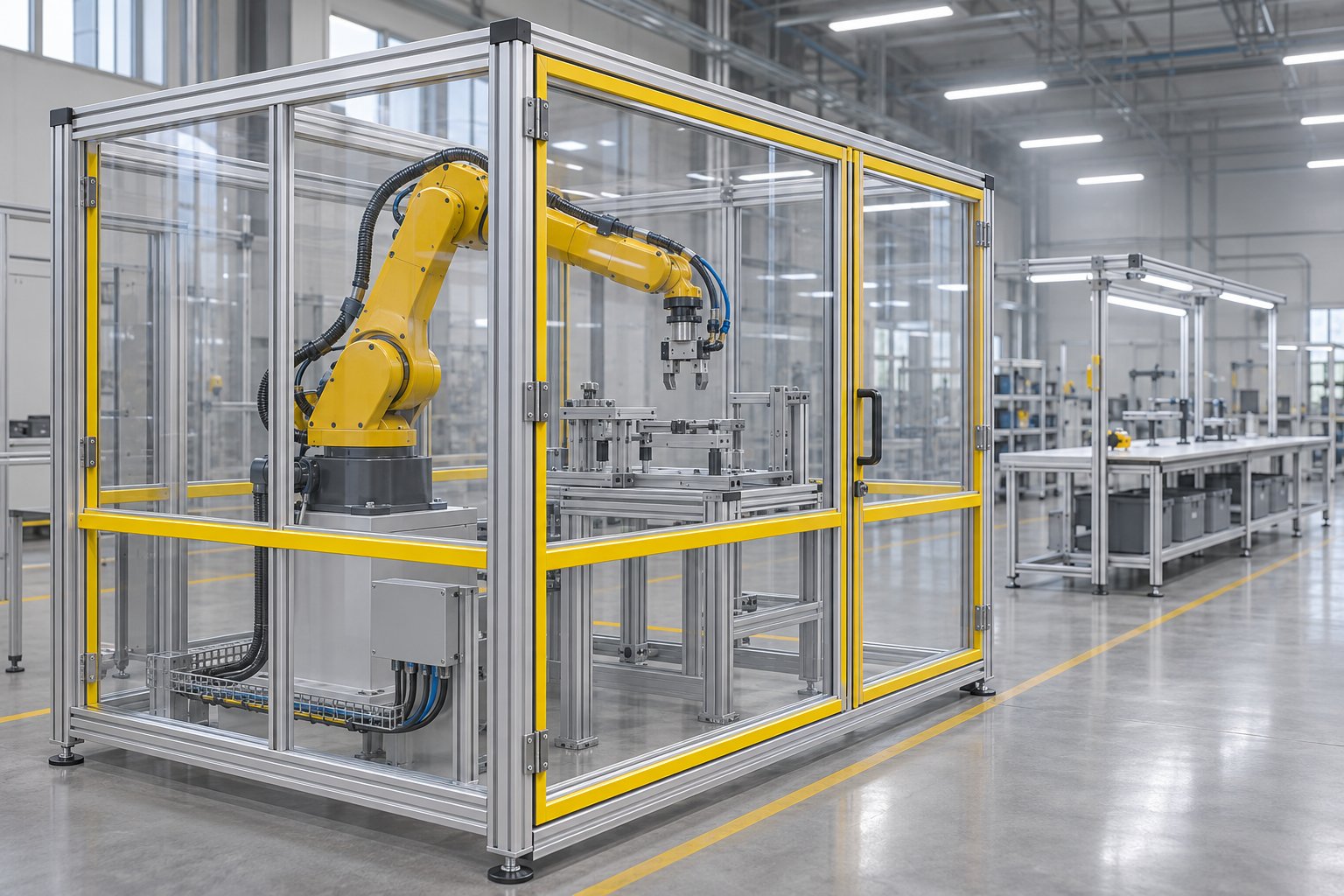
When you walk through a modern plant, you'll often find t slot aluminum framing in several places at once. It may surround a robot, sit under a test fixture, and hold a monitor above an assembly bench. Supplier catalogues show which uses come up most often. Each use depends on a different design factor.
Guarding is the most visible use. One supplier's automation guarding range includes wire mesh machine guarding, robot cell and automation guarding, and custom enclosures built closely around a single machine. It also sells clear polycarbonate and yellow safety guarding. Each infill material does a different job. Wire mesh keeps the machine visible and lets heat escape from motors and drives. Clear panels give operators an open view of the process. Solid panels separate people from the work area more completely.
A t slot panel attaches to the frame in one of two ways. Its edge can sit inside the slot, usually with a gasket that fills the gap and stops rattling. A panel-mount bracket can also clamp the panel to the profile face with a T-nut. Doors, hinges, switches and sensors mount through the slot in the same way. Plan service access early in the design. Hinged doors and removable sections let technicians reach motors and tooling without taking the guard apart. The TSLOTS guarding page lists common guarding faults, including unstable floor fastening and guards that leave too little room for the machine and the operator.
Workstations, carts, fixtures and automation frames are the next large group. The TSLOTS automation page shows builds such as a leak detector cart, a vacuum fixture and an assembly station. Framing catalogues also list ergonomic lift tables and lift systems built on T-slot frames. These structures carry real loads, and sometimes moving ones. Size them with the deflection and joint checks from the previous section, and have an engineer review them.
An aluminum t slot frame is also common in modular display structures and in bases that hold machines, robots or conveyors. Displays are taken apart and rebuilt for each event. Machine bases have to keep equipment level and steady while it runs.
Each application depends most on one design factor:
Few of these frames keep their original layout. Robots get replaced, conveyors get extended, and new sensors are added. The frame has to be redrawn each time, so the software used to lay it out affects every later change.
Should you lay out your next frame in a supplier's configurator or in your own CAD system? Either can work. The two tools solve different problems, and the better choice depends on what the frame has to connect to.
Many aluminum framing systems come with their own design software. AQX, EZ Design and TBuild are examples. You drag profiles into place and add connectors. The tool then produces a bill of materials and a cut list that you can send with an order. If you're building a cart or workstation entirely from one supplier's parts, this is the fastest way to get from a sketch to a quote.
The tool's limit is its catalogue. Each tool knows only its own brand's profiles and hardware. It can't show you a connector from another brand, a custom bracket, or the machine the frame will hold.
A CAD library brings the parts into the design software you already use. You download profile models from the library and place them in your own assembly. For example, TSLOTS by Bonnell Aluminum publishes its CAD catalog on TraceParts. Its models come in a wide range of downloadable formats so designers can import them into their own projects.
A library is the better choice when an assembly mixes brands or when the frame has to fit inside a larger machine model. It also lets you check clearances against motors, conveyors or a robot's reach before you cut anything. In exchange, you usually build the bill of materials and cut list yourself.
A clean 3D model can still carry the wrong data. Before you order aluminum extrusion profiles from any tool's output, check these points:
Most of the errors this list catches come from assumptions the designer brought into the software, and the same few appear on project after project.
Have you ever built a t-slot aluminum frame that went together easily and then started to loosen or sag a few weeks later? Problems like this usually start on the order form, well before assembly.
A fastener that clearly doesn't fit gets noticed and sent back. The risky one is the fastener that nearly fits. As the slot width section showed, a 15 Series slot measures 0.32 in, about 8.1 mm, which is close to a metric 8 mm slot. A metric nut can drop into it but bear on less of the slot lip than it was designed for, so it may turn or loosen under vibration. A nut that is slightly too wide won't seat, and forcing it in can bend the lips. On top of that, M threads and inch threads have different pitches. One metric vs imperial guide puts it plainly: a bolt that enters the slot is not proof of a safe or repeatable connection.
Two extruded aluminum profiles with the same outline can bend very differently. Wall thickness, internal webs and hollow chambers all change the moment of inertia. Framing Tech sells light, regular and heavy versions of its profiles and notes that a light profile can weigh about 25% less than a comparable regular one. The two 1 in square TNUTZ profiles from the data sheet section show the same thing on a small scale, with Iy values of 0.046 and 0.057 in4. Compare the section properties on the data sheet as well as the outside size.
The color of a dyed finish comes from dye absorbed into the oxide layer. It tells you nothing about how thick that layer is. Outdoor durability depends on the anodize type and the coating thickness. Type II coatings alone range from 0.0001 to 0.001 in, so two profiles with the same color can carry very different protection.
Watch for these other common mistakes:
Before you order, confirm three things and write them into your supplier request: the unit system and slot width, the section properties for your span and load direction, and the anodize spec for the frame's environment.

When you search "where to buy 8020 aluminum extrusion" or "t-slot profiles near me," the results mix three kinds of seller. Each kind suits a different stage of a project.
Branded framing system suppliers sell profiles together with matched connectors, design software and cut-to-length service. 80/20 says many of its standard profiles ship from stock, while custom extrusions, machining and large orders take longer. Local distributors stock a brand's range closer to you, so delivery is faster and small orders are easy to place. Aluminum extrusion manufacturers take inquiries for specific profiles, including custom sections. They suit larger volumes, but a new section may need a die and a minimum run. One extrusion cost guide puts typical extruder minimums at 1,000 to 2,000 lb per shape, while many distributors set no minimum.
So what do you get when you search "aluminum extrusion t-slot best price"? A fair price comparison needs a spec behind it. Price depends on weight per foot, cut length, finish and quantity. A lite profile and a standard profile with the same outline are priced differently, and so are clear and black anodize. The AL Circle RFQ guide warns that the lowest price per kilogram can leave out tooling, finishing, packaging or freight. Only compare quotes that describe the same profile, finish, lengths and delivery terms.
A supplier can only quote accurately if nothing has to be guessed. AL Circle tells buyers to name the alloy and temper together and to require suppliers to declare any deviations. For a T-slot order, include:
If your request covers all eight points, any price difference between suppliers reflects their offer and not a different reading of your spec. You also get a written record to check the delivered profiles against.
These names give the cross-section as width by height, and the series sets the unit. Fractional profiles use inches: the 10 Series is built on a 1 in base and the 15 Series on a 1.5 in base. Their names usually have no prefix, so a 1010 is 1 x 1 in and a 1530 is 1.5 x 3 in. Metric profiles in the 20, 25, 30, 40 and 45 Series are measured in millimeters and normally carry a prefix, as in 20-2020 for a 20 x 20 mm section. The prefix matters because a fractional 2020 is a 2 x 2 in part with two slots per face, about 2.5 times wider than the metric 20-2020. Similar sizes also cause mistakes. 25 mm is about 0.984 in, so a 25 Series profile and a 10 Series profile look almost the same on the bench, but they use different slots and threads. Check the unit system on the data sheet before you order.
No. Use one hardware system for the whole frame. Some slot openings look close, such as a 15 Series slot at 0.32 in (about 8.1 mm) and a metric 8 mm slot. Even so, the lip thickness, inner cavity depth and nut shape were designed separately for each system. A metric nut may slide into a fractional slot but grip only part of the lip, so it can spin or loosen under vibration. A nut that is slightly too wide can bend the lips if you force it in. Threads are a second mismatch, because inch bolts will not thread into M-thread nuts. Slot widths also vary between brands within the same nominal series. A label like '80/20 compatible' only means something after you compare slot width, slot depth and thread size on both data sheets. If a T-nut turns instead of locking when you tighten it, check for a slot or thread mismatch first.
Use a standard beam deflection formula with the moment of inertia from the profile data sheet. For a beam supported at both ends with a load at the center, deflection = P x L^3 / (48 x E x I). P is the load, L is the span, E is the modulus of elasticity (about 9.9 million psi for 6105-T5), and I is the moment of inertia about the bending axis. An EX-1010 profile (I = 0.046 in^4) spanning 36 in with 50 lb at mid-span gives about 0.107 in of sag. That is slightly more than the 1/10 in limit some frame builders use. The span is cubed in the formula, so doubling it makes the sag eight times larger. Adding a support at mid-span often works better than moving to a bigger profile. A stronger alloy will not reduce sag much, because 6xxx alloys have nearly the same stiffness. Treat hand calculations as estimates, and have an engineer review any frame that lifts loads or carries people.
It can be, but the color tells you nothing about durability. Clear, black and yellow finishes can each sit on oxide layers of very different thickness. Under MIL-A-8625, Type II sulfuric anodize ranges from about 0.0001 to 0.001 in (2 to 25 microns). Type III hardcoat can reach 0.004 in and resists wear much better. For outdoor, washdown or humid sites, ask the supplier which anodize type and specification is applied, what the minimum coating thickness is, whether the coating is sealed, and which cleaning chemicals it has been tested against. Cut ends and drilled holes are usually bare aluminum after fabrication. The fastener material also matters wherever steel touches the profile. A vendor's claim that a finish suits indoor and outdoor use is only useful when these specs come with it in writing.
Buyers usually choose between three kinds of supplier. Branded framing system suppliers sell profiles with matched connectors, design software and cut-to-length service. Local distributors suit small orders, quick pickups and replacement parts. Extrusion manufacturers make specific or custom profiles in volume. They often set minimums of about 1,000 to 2,000 lb per shape and may charge for a die on a new section. Shengxin Aluminium's T-slot profile collection is one option for equipment builders, automation integrators and fabrication teams. It lets you compare profile configurations for frames, workstations, display structures or machine supports and turn a concept into a manufacturing inquiry. Confirm the slot dimensions, cross-section, finish and connectors for the profile you choose, because a listing does not guarantee fit with every third-party system. In any quote request, state the unit system, slot width and thread, a drawing, the required moment of inertia and its axis, the alloy and temper, the anodize spec, lengths, tolerances, quantities and the connectors you need.



 dịch vụ trực tuyến
 0086 136 3563 2360
 sales@sxalu.com
 +86 136 3563 2360
 Việt
 English
 français
 Deutsch
 русский
 español
 português
 العربية
 ไทย
 Українська