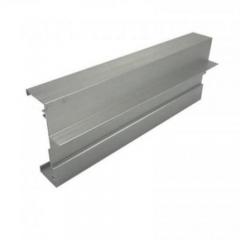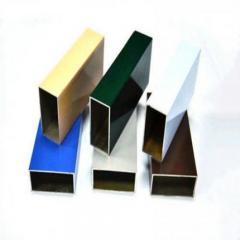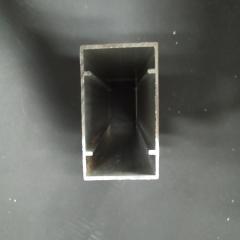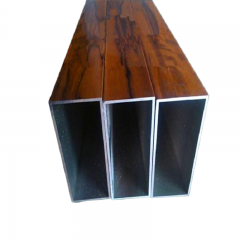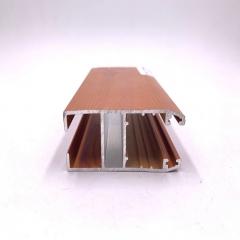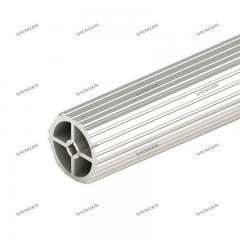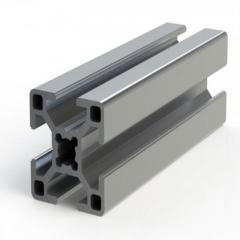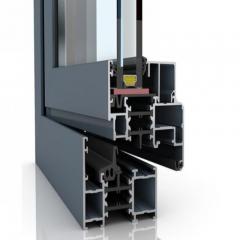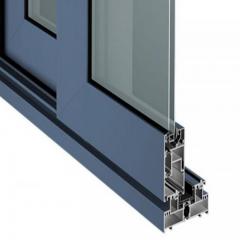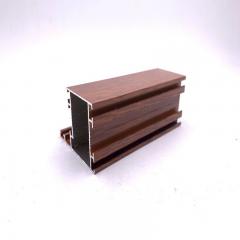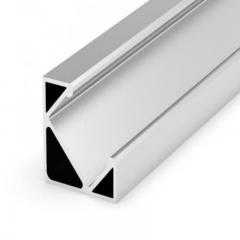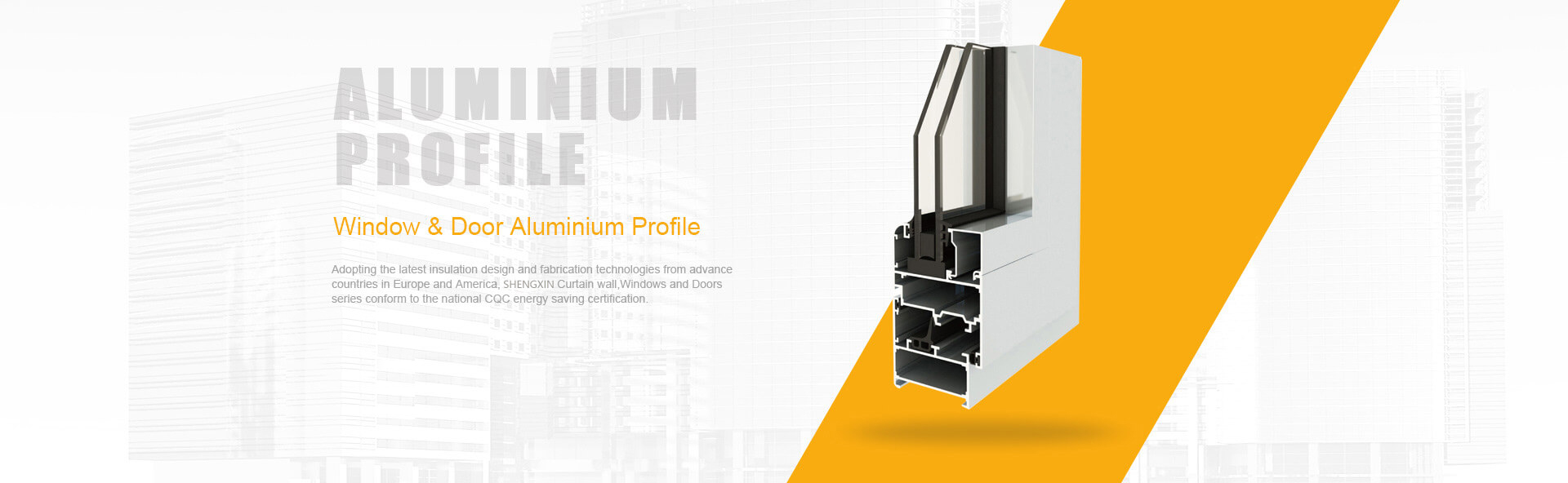
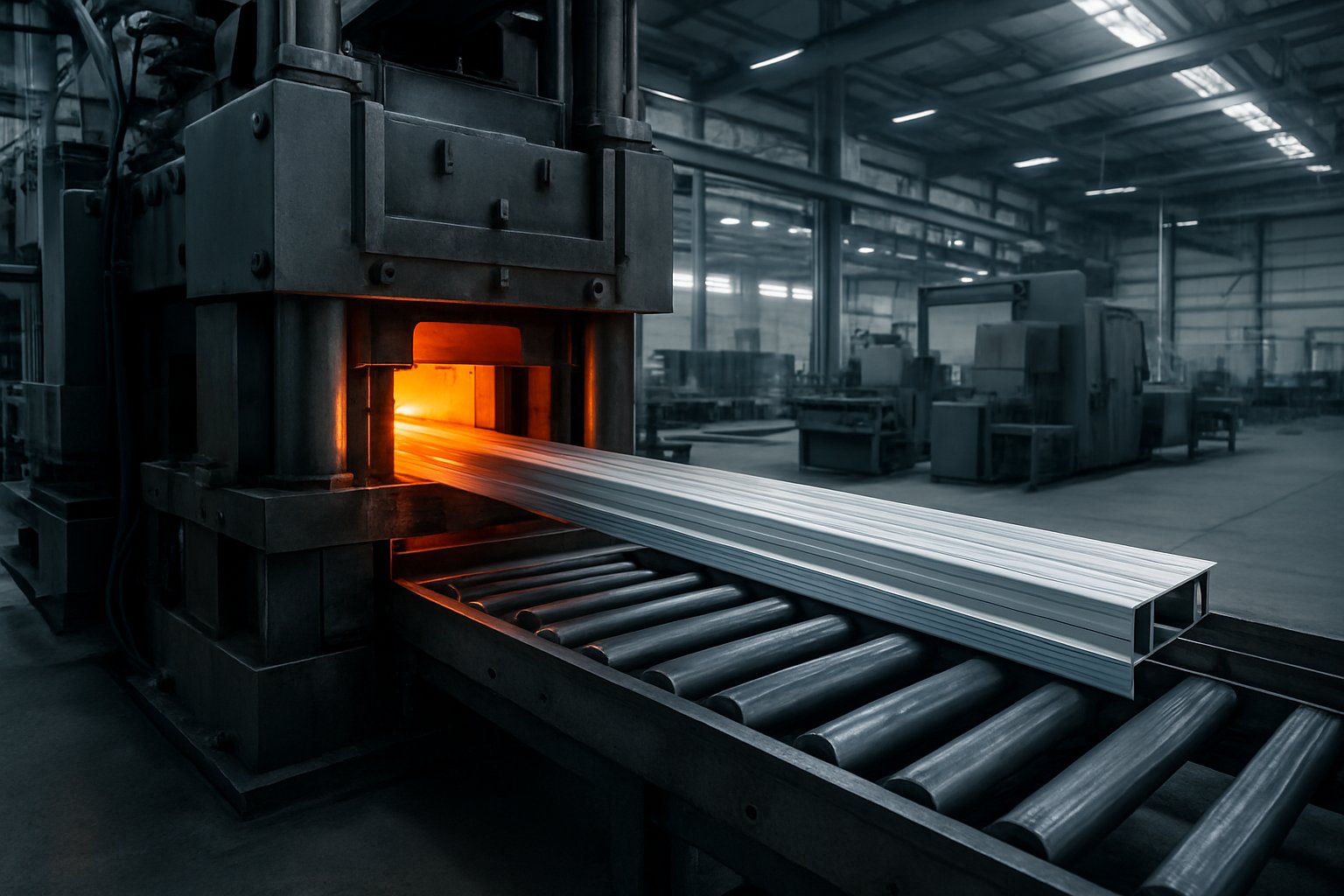
An aluminum extruder usually means the company or operation that produces aluminum shapes by pushing heated metal through a die. In strict shop-floor language, though, the extruder is not the same thing as the press, the process, or the finished part. That distinction matters when you are sourcing anything from channels and enclosures to structural profiles, extruded aluminum framing, extruded aluminum rails, or extruded aluminum tubing.
If you have searched what is extruded aluminum, the short answer is this: it is aluminum that has been forced through a shaped die opening so the emerging length matches that cross-section. Bonnell Aluminum describes extrusion as a shaping process in which material flows through a die, creating a long piece with the same profile as the opening.
The extruder is usually the producer, the press is the machine, and the profile is the finished shape.
Buyers ask for an aluminum extruder when they may actually need a press size, a custom die, or a finished profile ready for anodizing. Engineers may specify extruded aluminum tubing or extruded aluminum rails, while procurement is comparing supplier capability. Clean terminology prevents quoting errors, mismatched expectations, and confusing conversations about lead time, tolerances, or finish. It also sets up the real question behind every project: how the line turns billet into usable extruded aluminum framing, rails, and other shapes step by step.
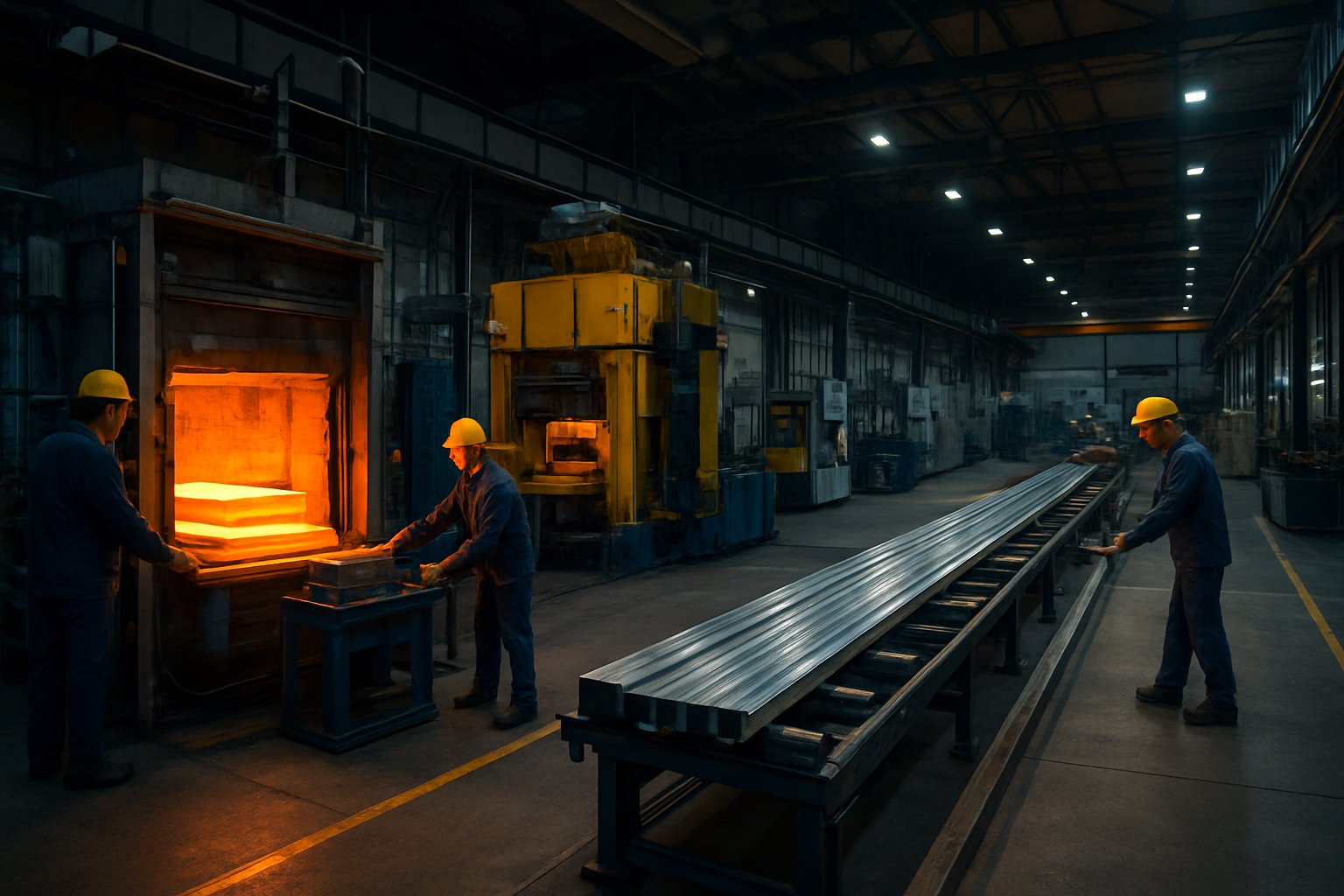
Terminology helps, but the real picture appears on the line itself. If you are asking how is extruded aluminum made, think of it as a controlled chain rather than one hard push through a die. Search phrases like extruding aluminum or aluminum extrude make the job sound simple. In practice, every stage affects straightness, surface quality, dimensional control, and how ready the profile is for machining or finishing.
Before the press starts, temperature and tooling set the baseline. Process overviews from RapidDirect and ADM describe preheating the die to about 450-500 C and the billet to roughly 400-500 C so the alloy stays solid but becomes workable enough to flow.
That is why a well-run line does more than make shape. It controls a sequence of heat, force, cooling, and handling decisions. The same workflow can behave quite differently, though, depending on how the machine applies pressure and where friction builds inside the system.
The process chain does not end at the press stroke. The way force is applied changes how metal flows, how heat builds, and how predictable the finished section becomes. That is why direct and indirect extrusion can both make extruded aluminum profiles, yet produce different outcomes in straightness, surface quality, die wear, and run-to-run consistency. For buyers comparing aluminum extruded shapes, machine behavior quickly turns into product consequences.
In direct extrusion, also called forward extrusion, the billet is pushed through a stationary die while the billet itself moves forward. Because the billet rubs against the container wall, friction is higher. Notes from AMSpec and BCB describe how that added friction raises required force and makes temperature control less uniform. Even so, direct extrusion remains the most common route because it is broadly available and flexible across many extruded aluminum shapes. For a structural extruded aluminum frame with slots, webs, or attachment features, this is often the familiar process path.
Indirect extrusion, or reverse extrusion, flips that setup. The billet stays stationary while the die moves toward it. With much less billet-to-container friction, the press usually needs lower force and sees steadier pressure and temperature. Howard Precision and AMSpec both highlight the payoff: more uniform metal flow, smoother surfaces, and tighter dimensional control. That can matter when an extruded aluminum rail, thin-wall tube, or other precision section must need less correction after extrusion. The tradeoff is practical rather than theoretical. Depending on the press design, indirect equipment can be less versatile for some larger or more varied profile families.
| Factor | Direct extrusion | Indirect extrusion | What it means in production |
|---|---|---|---|
| Tooling movement | Billet moves, die stays fixed | Billet stays still, die moves | Machine motion changes where drag and heat build up |
| Friction | Higher | Lower | Lower friction usually means lower load and steadier flow |
| Pressure and temperature | Higher force, less stable temperature profile | Lower force, more stable temperature and pressure | Stability supports repeatability and dimensional control |
| Likely profile quality | Good general performance, but demanding sections can be harder to hold consistently | Often better surface finish and tighter tolerance capability | Important for appearance-sensitive and precision parts |
| Complexity and hollow sections | Widely used for many structural and complex profiles | Well suited to precision tubing and custom sections, though machine limits matter | Geometry has to be matched to actual press capability |
| Die wear | More friction can increase wear over time | Reduced friction can extend tool life | Tool life affects cost stability and repeat orders |
| Common use cases | General structural sections and many extruded aluminum frame designs | Precision profiles, tubing, and cleaner-finish extruded aluminum rail applications | The best fit depends on end-use requirements, not just habit |
There is no universal winner across the many types of extruded aluminum. Direct extrusion usually makes sense when you need broad manufacturing availability, flexible production, and cost-effective output for common structural profiles. Indirect extrusion makes sense when lower friction can translate into better finish, more stable dimensions, and more uniform properties. Hollow, semi-hollow, and complex sections can be produced by either route, but not with the same ease on every machine.
For procurement teams, the smartest choice is the method that gives the profile the finish, stability, and repeatability the end use actually needs.
That choice rarely stands alone. The same profile can behave very differently once alloy enters the picture, especially when strength, corrosion resistance, and anodizing response start pulling in different directions.
Machine behavior shapes metal flow, but alloy choice decides what that flow can realistically deliver. Guides from Ya Ji and Tri-State Aluminum point to a clear pattern in the 6000 series: 6063 favors extrudability and appearance, 6061 balances strength with machinability, and 6082 leans harder into structural performance. That is why two profiles with the same shape can behave very differently in cost, finish quality, and downstream processing.
Think of these alloys as three different priorities. 6063, often specified as extruded aluminum 6063, is widely used for architectural profiles, door and window sections, trim, and other parts where a smooth surface matters. 6061 is a versatile choice for machined components, enclosures, manifolds, and general structural members because it combines good corrosion resistance with strong machining performance. 6082 is one of the stronger 6000-series options and is commonly associated with load-bearing frames, transport structures, industrial bases, and marine-oriented applications.
| If your main priority is | Start with | Why it fits | Typical use context |
|---|---|---|---|
| Clean surface and anodizing appearance | 6063 | Excellent extrudability and strong finish quality | Architectural profiles and anodized extruded aluminum parts |
| Balanced strength plus CNC work | 6061 | Higher strength than 6063 with excellent machinability | Machined brackets, enclosures, and structural parts |
| Highest structural strength of these three | 6082 | Better suited to heavy-duty members and tougher service | Transport, marine, and industrial frames |
| Small cooling sections with appearance needs | 6063 | Handles intricate fins and finishes well | Light extruded aluminum heatsink profiles |
| Heavier thermal parts needing machining | 6061 | Supports drilling, milling, and tapping after extrusion | Industrial extruded aluminum heat sink material |
Strength is only one axis. 6061 is generally stronger than 6063 and is a better fit when the profile will be drilled, tapped, or precision machined. 6063 gives up some strength, but its extrusion behavior is smoother and its finish is typically better, especially when a uniform anodized look matters. Material comparisons from Chalco also note that 6063 tends to respond better in surface treatment, while 6061 is preferred for high-precision machining. 6082 offers very strong structural performance and excellent corrosion resistance, but it is more difficult to extrude and is usually less finish-driven than 6063.
In practice, 6063 suits visible profiles, 6061 suits machined and mixed-duty parts, and 6082 suits heavier structural work. The right pick depends on what the part must do after it leaves the press, not just how strong the data sheet looks.
Even a well-chosen alloy can become expensive or difficult when the profile geometry fights the process. Wall thickness, radii, hollows, and tolerance demands often decide whether a design runs smoothly or turns into a tooling problem.
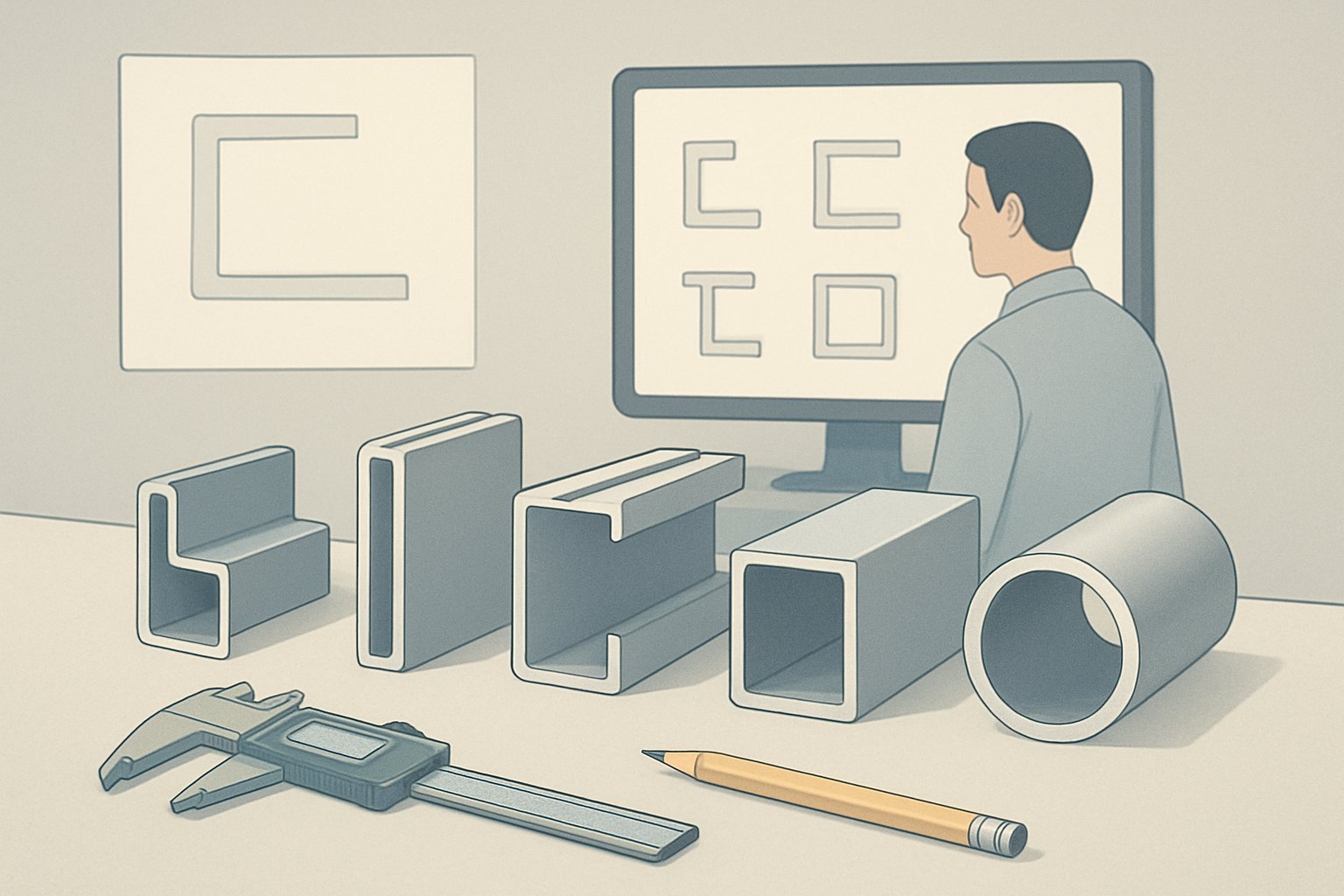
Alloy choice sets the material baseline, but profile geometry decides whether that alloy runs cleanly or turns into a costly die problem. An extrusion DFM guide from Ya Ji and design notes from Bonnell keep returning to the same point: metal flow, die support, and section size drive feasibility just as much as strength or temper. That is true whether the part is a simple extruded aluminum channel, an extruded aluminum tube, or a custom structural section.
Uniform walls are one of the safest ways to improve manufacturability. Ya Ji recommends treating a 2:1 wall-thickness variation as a practical starting limit across a profile, because thick zones tend to let metal move faster while thin zones lag behind. When that balance gets lost, straightness, dimensional control, and surface quality usually suffer. Bonnell makes a similar point and notes that abrupt transitions can also create uneven cooling.
Corner shape matters for the same reason. Smooth blends and rounded internal corners help guide metal through the die, while sharp steps and knife-edge features concentrate stress and make streaks more likely. That is why common frame formats such as 2020 extruded aluminum, 20x20 extruded aluminum, and 2040 extruded aluminum are usually easier to run when slot walls stay balanced and corners are radiused instead of treated like folded sheet metal. Exact limits still depend on alloy, die design, press range, and the supplier's handling method.
Complexity rises fast when a profile shifts from open to semi-hollow or hollow. Bonnell classifies shapes as solid, semihollow, or hollow, and uses gap ratio to judge when a narrow opening becomes a semihollow condition. In practical terms, what many engineers call tongue-ratio risk shows up when narrow, deep slots, thin lips, tall fins, or multi-void hollows leave less support for the die and make flow harder to balance.
Ya Ji adds a useful rule of thumb for fin-like features: keeping height-to-gap near 4:1 or below helps reduce die breakage and waviness risk. So an open extruded aluminum u channel is generally easier than a multi-void extruded aluminum tube with thin internal webs. The same logic applies to custom rails, heat sinks, and framing profiles.
Small cross-section decisions show up everywhere on the shop floor. A larger circumscribing circle diameter, or CCD, can push the job onto a bigger press and narrow the supplier pool. Ya Ji notes that many general-purpose presses prefer profiles within about 203 mm CCD, while larger sections may require more tonnage and specialized tooling. That is why extruded aluminum sizes are not just catalog labels. They influence die cost, press availability, run speed, and lead time.
| Design factor | Simpler profile feature | More demanding profile feature | Common production effect |
|---|---|---|---|
| Section type | Open channel or simple solid | Multi-void hollow | Higher tooling complexity and slower runs |
| Wall layout | Uniform thickness with smooth blends | Abrupt thick-to-thin jumps | More distortion, scrap, and surface variation |
| Edges and gaps | Radiused corners and moderate openings | Sharp corners, thin lips, deep narrow slots | More die stress and streak risk |
| Size envelope | Compact CCD | Large CCD with long cantilevers | Fewer press options and longer lead times |
A profile that runs well usually costs less to machine, wastes less metal, and arrives straighter with a better surface. Those geometry choices do not stop at the press either. They carry straight into drilling, tapping, cutting, anodizing, powder coating, and final inspection.
A profile can leave the press with the right shape and still be far from ready for use. A GCS fabrication overview puts the real handoff in perspective: cutting, straightening, CNC machining, finishing, assembly, inspection, and packaging all help turn an extrusion into a functional part. For rails, housings, and heat-dissipation components, a large share of the final value is created in these downstream steps.
Cutting, drilling, tapping, milling, pocketing, and slotting add the details a die usually should not carry alone. That is where extruded aluminum cnc work becomes practical. An extruded aluminum enclosure may need connector cutouts and mounting holes. An extruded aluminum case may need tapped ends for fasteners. An extruded aluminum heat sink may keep its fins as-extruded while the base is machined for flatness or assembly features.
Finish selection changes both performance and appearance. Can Art notes that anodizing creates an integral oxide layer with excellent corrosion resistance, high abrasion resistance, and strong UV stability while preserving aluminum's metallic look. Powder coating adds a cured film with broad color and texture options and reliable corrosion protection when pretreatment is done correctly. That is why black extruded aluminum can mean two different priorities: black anodizing for a metallic finish, or black powder coating for wider visual flexibility.
| Finish option | Appearance | Corrosion performance | Typical use context |
|---|---|---|---|
| Natural or clear anodized | Clean metallic look | Excellent | Visible rails, trims, and parts where a bright aluminum finish matters |
| Black anodized | Dark metallic appearance | Excellent | Extruded aluminum enclosures, electronics housings, and premium black profiles |
| Powder coated | Wide color and texture range | Very good with proper pretreatment | Color-matched panels, an extruded aluminum enclosure box, and decorative or branded assemblies |
Downstream work can also include bending, welding, mechanical fastening, heat treatment, and sub-assembly, again reflected in the GCS process list. These steps add value when they reduce customer assembly work or improve functional readiness.
Quality control has to match the part's job, not just the drawing. The Ya Ji inspection guide highlights visual checks for scratches, dents, pits, corrosion spots, extrusion lines, and coating uniformity. Dimensional inspection then covers width, height, wall thickness, length, straightness, and twist, using tools from calipers and micrometers to CMM systems for more complex sections. For coated parts, the same guide points to eddy current checks for anodizing thickness, cross-hatch testing for powder-coat adhesion, and salt spray testing when corrosion resistance needs verification. Heat-dissipation profiles may also require functional checks such as thermal testing or fitment.
Buyers are not really purchasing a shape alone. They are purchasing machining discipline, finishing control, inspection rigor, and handling quality across the full chain. Those differences become hard to ignore when parts need cosmetic consistency, repeatable assembly fit, or several post-extrusion steps under coordinated control.

Inspection, machining, and finishing only create value when a supplier can coordinate them without losing control of schedule or quality. For buyers searching where to buy extruded aluminum or even extruded aluminum near me, that is the real filter. The better question is not simply who can sell a profile, but which aluminum extruders can support the alloy, geometry, finish, and follow-on work your part actually needs. That becomes even more important on custom extruded aluminum projects, where die development, CAD revisions, and prototype timing can reshape the whole schedule.
A practical checklist from AL Circle keeps the conversation focused on capability before price. Useful questions include:
Those questions quickly separate stock sellers from true production partners. Many extruded aluminum manufacturers can quote a shape. Fewer can explain how they will keep that shape on tolerance and move it cleanly through machining, finishing, inspection, and shipping.
Low piece price can hide slow tooling, outsourced finishing, weak inspection discipline, or poor communication when drawings change. Even if your search started with familiar framing terms like bosch extruded aluminum, misumi extruded aluminum, or item extruded aluminum, catalog familiarity does not replace supplier due diligence.
| Evaluation factor | What to verify | Why it matters |
|---|---|---|
| Extrusion capacity | Press range, billet size, profile envelope, alloy coverage | Shows whether the supplier can actually produce the section instead of stretching capability claims |
| Tooling and CAD support | Die development process, CAD review, prototype support | Helps reduce redesign loops and speeds up custom profile decisions |
| MOQ and lead time | Tooling timing, batch size flexibility, schedule communication | Protects launch plans, inventory levels, and customer commitments |
| CNC and fabrication | Cutting, drilling, tapping, machining, assembly support | Reduces extra handoffs after extrusion |
| Finishing | Anodizing, powder coating, mechanical finishing, in-house or outsourced status | Affects appearance, corrosion performance, cost, and timing |
| Quality checks | Tolerance standards, certifications, inspection routines, rejection controls | Helps prevent rework, fit problems, and shipment disputes |
| Project fit | Packaging, export readiness, documentation, responsiveness to drawing updates | Reveals whether the supplier fits your job, not just a generic profile category |
The same AL Circle guidance notes that in-house finishing typically improves consistency and shortens lead time, while outsourced work can delay production and complicate quality control. Outsourcing is not automatically a red flag, but it should never be invisible. Every extra handoff adds another chance for schedule drift, finish variation, or communication loss.
That is why integrated suppliers often stand out when a part needs more than a bare extrusion. One example is Shengxin Aluminium, which describes an in-house setup with more than 30 years of experience, 35 extrusion presses, precision CNC machining, and multiple anodizing and powder coating lines. For buyers evaluating aluminum extruders, that kind of consolidated processing can simplify sourcing when the job includes machining and finishing as well as the extrusion itself.
The shortlist becomes much stronger once each candidate is tested against the same brief. At that point, supplier hunting gives way to something more useful: a clear decision document that ties function, alloy, geometry, finish, tolerance, and downstream work into one smart extrusion plan.
A supplier shortlist only works when every quote is built on the same brief. For buyers comparing stock sections, custom dies, or even searching aluminum extruders near me, the practical win is clarity. The more clearly you define the part, the easier it becomes to judge cost, fit, finish, and timing before tooling starts.
The checklist from Profile Precision Extrusions starts with the details many RFQs skip: a sketch or CAD file, target dimensions and tolerances, alloy and temper, cosmetically important surfaces, any coating such as anodize or paint, finished length, quantity, machining needs, and lead-time expectations. That same brief should also note whether the part must work with extruded aluminum connectors, extruded aluminum accessories, or other extruded aluminum hardware.
The Shengxin guide frames alloy choice as a balance of extrudability, strength, corrosion resistance, and cost, while also stressing design practices such as uniform walls, smooth transitions, quality control, and finishing support. In real sourcing, that means locking in alloy and finish early instead of treating them as late-stage edits. A basic extruded aluminum profile is usually easier to source than one that gains extra machining, tighter cosmetic demands, and revised coating requirements after the die discussion has already started. The same logic helps when weighing stock aluminum extruded profiles against a custom design.
Match design intent to real process capability before you compare price.
That last filter matters most on custom work. If you are reviewing custom aluminum extruders rather than buying a simple stock section, an integrated source can reduce handoffs. Shengxin Aluminium is one example. The company states it has more than 30 years of manufacturing experience, 35 extrusion presses, precision CNC machining, and multiple anodizing and powder coating lines, making it a useful next-step resource for projects that need extrusion plus downstream processing from one partner.
In most buying conversations, an aluminum extruder means the company or production operation that makes aluminum shapes. It does not mean the same thing as the press itself, the extrusion method, or the finished profile. Keeping those terms separate helps when discussing tooling, tolerances, cut length, machining, and finishing requirements.
Direct extrusion pushes the billet through a fixed die, so friction against the container is higher. Indirect extrusion moves the die toward a stationary billet, which usually reduces friction and can improve flow stability. In practical terms, that difference can affect surface quality, dimensional consistency, required press force, and how suitable each method is for a given profile.
The best alloy depends on the job. 6063 is often chosen when appearance and anodizing quality matter most, 6061 is a strong all-round option for parts that will also be machined, and 6082 is commonly considered for more demanding structural use. A good selection balances strength, corrosion behavior, finish expectations, and post-extrusion operations rather than focusing on one property alone.
Designs become more difficult when they use abrupt wall changes, sharp internal corners, deep narrow slots, thin unsupported lips, or complex hollow sections. These features can make metal flow less even and place more stress on the die. The result may be slower production, more scrap, tougher finishing control, and higher secondary machining effort.
A supplier that handles extrusion, CNC work, anodizing, and powder coating under one roof can reduce handoffs and simplify schedule control. That often helps with consistency, communication, and traceability, especially on custom parts that need several downstream steps. For example, Shengxin Aluminium presents this integrated model with over 30 years of experience, 35 extrusion presses, CNC machining, and multiple anodizing and powder coating lines for projects that need a single manufacturing partner.



 dịch vụ trực tuyến
 0086 136 3563 2360
 sales@sxalu.com
 +86 136 3563 2360
 Việt
Việt English
 français
 Deutsch
 русский
 español
 português
 العربية
 ไทย
ไทย Українська