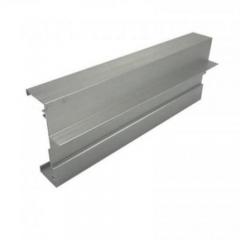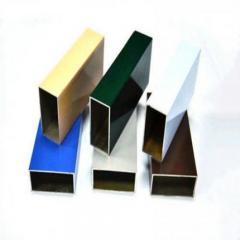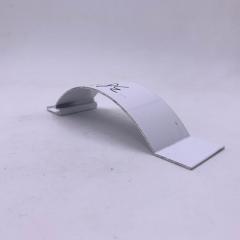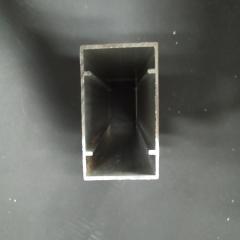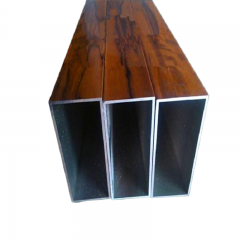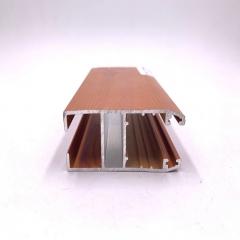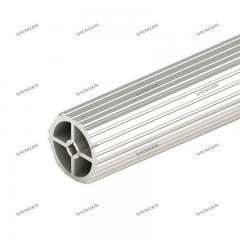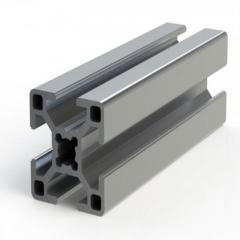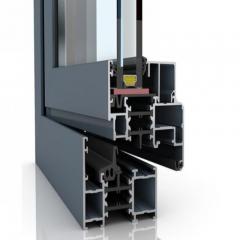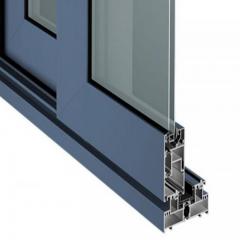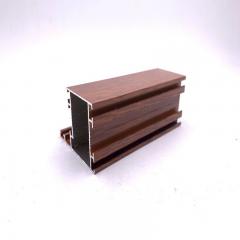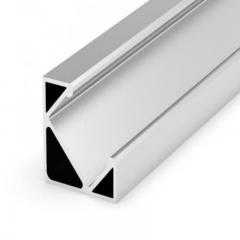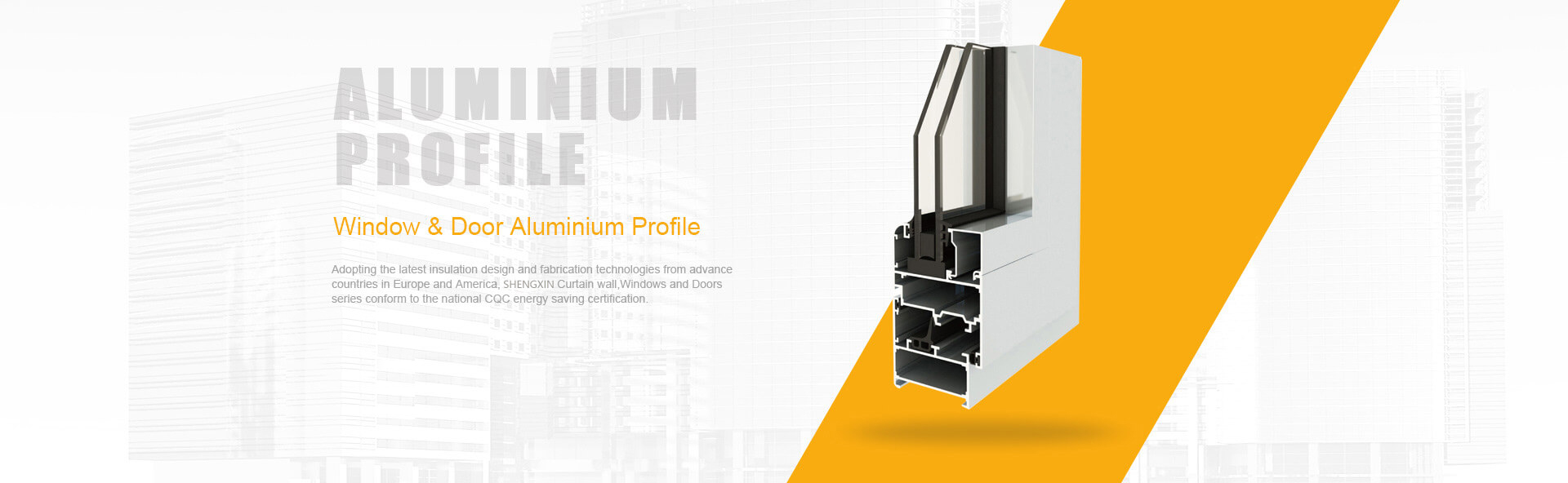
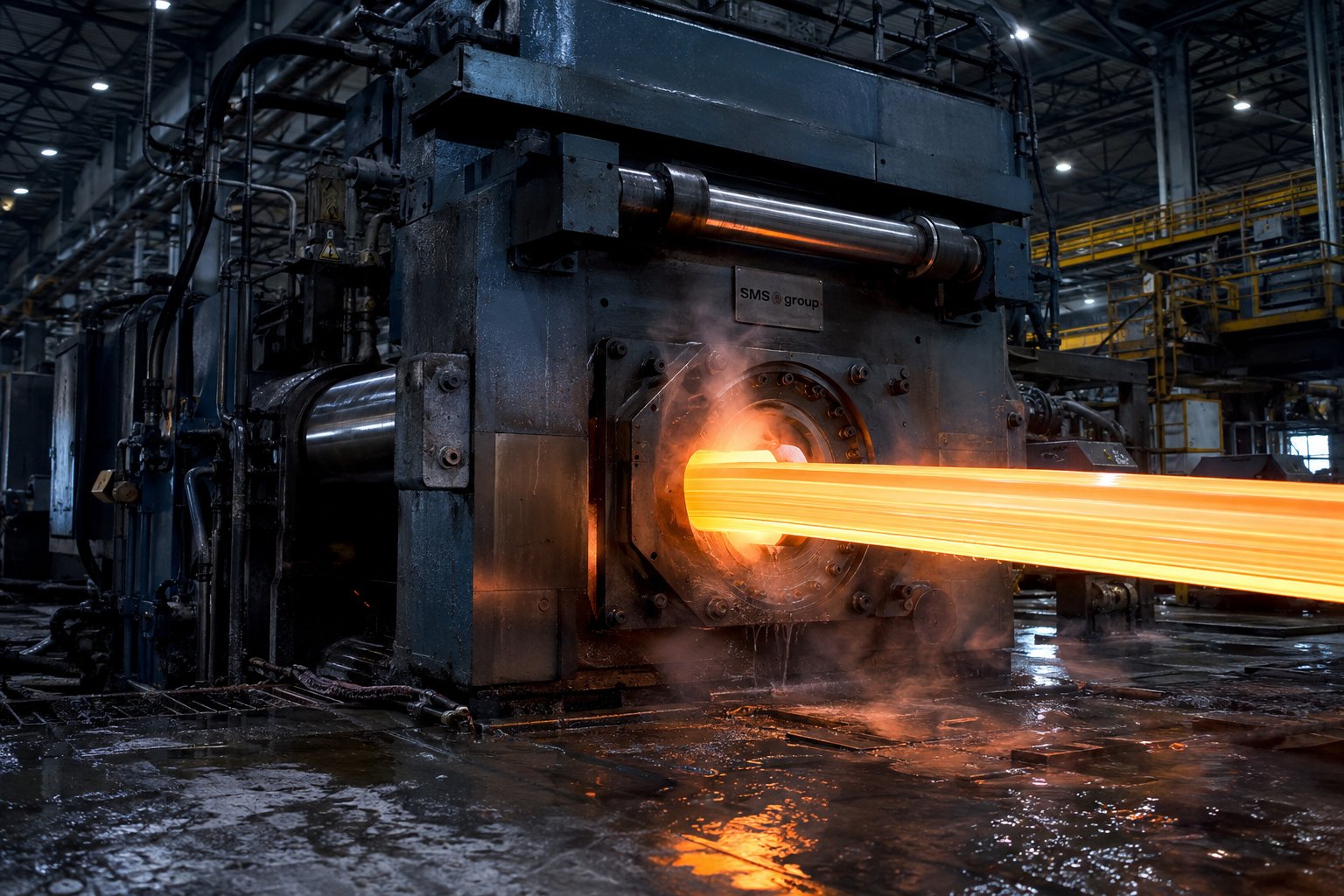
Ever wondered how manufacturers create those perfectly uniform aluminum channels, tubes, and complex shapes you see in everything from window frames to aircraft components? The answer lies in a fascinating process that transforms solid metal into virtually any cross-sectional shape imaginable.
So, what is aluminum extrusion? At its core, the aluminum extrusion definition is refreshingly straightforward:
Aluminum extrusion is a manufacturing process where heated aluminum billets are forced through a shaped opening called a die, creating continuous profiles with consistent cross-sections.
Picture squeezing toothpaste from a tube or pushing Play-Doh through a shape maker. The material emerges in whatever form the opening dictates. That's essentially what is extrusion in industrial terms—but with molten metal instead of paste, and precision-engineered dies instead of plastic toys.
When you define extruded aluminum, you're describing any aluminum product created through this forcing process. The extruded meaning extends beyond simple shapes to include incredibly complex geometries with hollow sections, intricate details, and tight tolerances that would be impossible or prohibitively expensive to achieve through other manufacturing methods.
The term itself reveals the process perfectly. "Extrude" comes from the Latin word extrudere, meaning "to push out" or "to thrust forth." This etymology captures the fundamental meaning extrusion carries—material being pushed outward through a defined opening to create a new form.
Understanding what is extruded aluminum matters significantly if you're an engineer designing structural components, a designer specifying architectural elements, or a procurement professional sourcing parts. The global aluminum extrusion market exceeded USD 90 billion in 2022, with projections showing strong continued growth. This isn't just an obscure industrial process—it's a cornerstone of modern manufacturing.
Why does this knowledge matter for your projects? Because aluminum extrusion offers an unmatched combination of design flexibility, cost efficiency, and material performance. When you understand how the process works, you can better leverage its capabilities—designing parts that are easier to manufacture, selecting appropriate alloys, and communicating effectively with suppliers. This article serves as your definitive resource, bridging basic understanding with technical application so you can make informed decisions at every stage of your project.
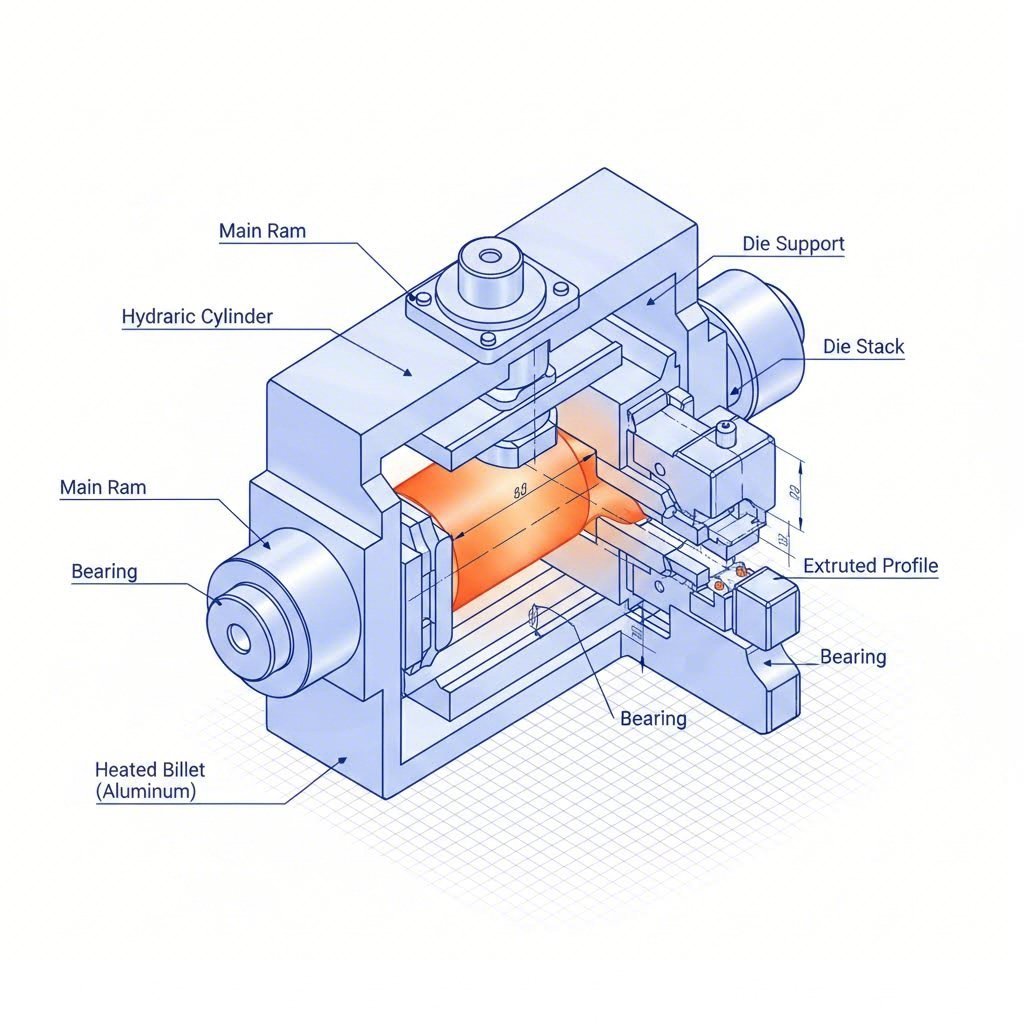
Now that you understand what aluminum extrusion means, let's explore exactly how aluminum extrusion is made. The aluminium extrusion process transforms a solid cylindrical billet into a precisely shaped profile through a carefully orchestrated sequence of steps. Each stage builds upon the previous one, and understanding this workflow helps you appreciate why certain design decisions affect manufacturability and cost.
The extrusion process begins long before metal meets die. A cylindrical aluminum alloy billet—essentially a solid log of aluminum—must be prepared and heated to achieve optimal plasticity. According to the Australian Aluminium Council's Extrusion Manual, billets are typically heated to between 450°C and 500°C (approximately 840-930°F). This temperature range is critical: too cold and the aluminum won't flow properly through the die; too hot and the material properties degrade.
Temperature control affects everything downstream. The heated billet must reach approximately 900°F (482°C) for optimal malleability, as noted by industry sources. Deviations from this range can lead to surface defects, dimensional inconsistencies, or even die damage. Professional extruders use sophisticated heating systems that ensure uniform temperature throughout the billet before it enters the press.
The extrusion press is the powerhouse of the operation. These hydraulic machines can exert thousands of tons of pressure, forcing the softened aluminum through the die opening. But how is aluminum extrusion made in terms of mechanical forces? The aluminum extrusion press uses a ram or plunger that pushes against the heated billet, creating immense pressure that causes the metal to flow through the die aperture.
Press tonnage directly affects capability. Larger presses with higher tonnage can produce bigger profiles with larger circumscribing circles—the diameter of the smallest circle that completely encloses a profile's cross-section. This concept is fundamental to understanding design constraints. According to industry standards, profiles measuring up to 150mm in circumscribing circle diameter are considered average size, while medium-sized sections can measure up to 250mm, with very large sections reaching 375mm.
Here's the step-by-step breakdown of how the aluminum extrusion process unfolds:
Not all extrusion happens the same way. Understanding direct indirect extrusion differences gives you insight into why certain profiles might be manufactured using one method over another.
| Characteristic | Direct Extrusion | Indirect Extrusion |
|---|---|---|
| Billet Movement | Billet moves toward stationary die | Billet remains stationary; die moves toward billet |
| Friction | Higher friction between billet and container wall | Reduced friction—billet doesn't contact container |
| Force Required | Higher force needed due to friction | Lower force requirements |
| Best Applications | Most common; suitable for wide range of profiles | Long sections with uniform properties |
| Complexity | Simpler equipment and process control | More complex tooling arrangement |
In direct extrusion—the most widely used method—the ram pushes the billet through the container and die in the same direction. This approach is simpler but requires more force because of friction between the billet and container walls.
Indirect extrusion flips this arrangement. The billet stays stationary while the die moves toward it on a hollow stem. Because the billet doesn't slide against the container, friction drops significantly, requiring less force. This method is particularly beneficial for extruding long sections with uniform properties, though it's less common in Australia and many other markets.
The circumscribing circle concept governs what profiles any given press can produce. Think of it as the maximum "footprint" your design can occupy. The press size imposes limits on this circle—larger profiles require larger presses with greater tonnage capacity.
But size isn't everything. Profile complexity also matters. The extrusion ratio—calculated by dividing the billet's cross-sectional area by the profile's cross-sectional area—typically works best between 30 and 60 for direct extrusion. Ratios below 7 don't adequately work the material, potentially compromising mechanical properties. Ratios above 80 demand excessive breakthrough pressures that can damage dies.
With these fundamentals in place, the next consideration becomes material selection—specifically, which aluminum alloys perform best in the extrusion process and how their properties match your application requirements.
Choosing the right aluminum extrusion material can make or break your project. Pure aluminum has poor mechanical properties on its own—it's simply too soft for most industrial applications. But when alloyed with elements like magnesium, silicon, copper, and zinc, aluminum transforms into a versatile engineering material capable of meeting demanding performance requirements.
The 6000 series alloys dominate aluminium alloy extrusion because they offer an exceptional combination of extrudability, strength, and corrosion resistance. These magnesium-silicon alloys are heat treatable, which means their mechanical properties can be enhanced through controlled thermal processing. Understanding the differences between common alloys helps you specify the right aluminum extrusion profiles for your specific application.
Walk into any modern building, and you'll likely encounter 6063 aluminum without even realizing it. Often called the "architectural alloy," 6063 is one of the most commonly used alloys in the 6xxx series thanks to its excellent extrudability, surface finish, and corrosion resistance.
What makes 6063 so special for aluminium extrusion profiles? It flows beautifully through complex die shapes, emerging with a smooth, bright surface that accepts anodizing exceptionally well. The alloy typically contains around 0.6% silicon and 0.9% magnesium, which form magnesium silicide (Mg₂Si) during heat treatment—the compound responsible for its strength after processing.
This extruded aluminum alloy excels in applications where appearance matters as much as performance:
The trade-off? 6063 offers moderate strength compared to structural alloys like 6061. But for applications prioritizing aesthetics and corrosion resistance over maximum load-bearing capacity, it remains the go-to choice across the construction industry.
Selecting the optimal alloy requires balancing multiple factors—strength, formability, corrosion resistance, machinability, and cost. Here's how the most common types of aluminum extrusions compare:
| Alloy | Tensile Strength | Formability | Corrosion Resistance | Typical Applications |
|---|---|---|---|---|
| 6063 | Medium (30-35 ksi) | Excellent | Excellent | Architectural frames, decorative trim, tubing, electronics enclosures |
| 6061 | High (40-45 ksi) | Good | Very Good | Structural components, aerospace parts, marine applications, truck trailers |
| 6005 | Medium-High (38-42 ksi) | Good | Good | Ladders, rail profiles, structural tubing, building frameworks |
| 7075 | Very High (73-83 ksi) | Fair | Fair | Aerospace structures, high-stress components, military applications |
According to Tri-State Aluminum's specifications, 6061 offers excellent strength, corrosion resistance, and machinability—making it ideal for structural applications. However, it has a poorer finishing response than 6063, so it's typically chosen for internal load-bearing structures rather than exposed decorative elements.
The 6005 alloy bridges the gap between 6063 and 6061, providing higher strength than architectural alloys while maintaining better extrusion characteristics than 6082. It's particularly suitable for applications like furniture tubing and rail profiles where both finishing and strength matter.
For extreme strength requirements, 7075 stands apart as the strongest commercially available aluminum alloy, surpassing many mild steel grades. However, its reduced formability and lower corrosion resistance mean it requires protective finishes and is generally reserved for aerospace and defense applications.
You've probably seen designations like "6063-T5" or "6061-T6" on specification sheets. These temper codes indicate how the alloy has been heat-treated, which directly affects mechanical properties.
The most common aluminium extrusion types include:
What's the practical difference? Consider 6063-T5 versus 6063-T6. The T6 temper delivers higher tensile strength through additional heat treatment, while T5 maintains better formability—ideal for decorative applications requiring post-extrusion bending or shaping. Choosing between them depends on whether your priority is maximum strength or ease of fabrication.
For 6061, the T6 temper is most commonly specified for structural applications, offering tensile strengths around 45 ksi. The T651 variant adds a stretching step after heat treatment to relieve internal stresses, improving dimensional stability for precision machining.
With alloy selection clarified, the next step is understanding the vast range of profile shapes these materials can become—from simple solid bars to complex hollow sections with intricate geometries.
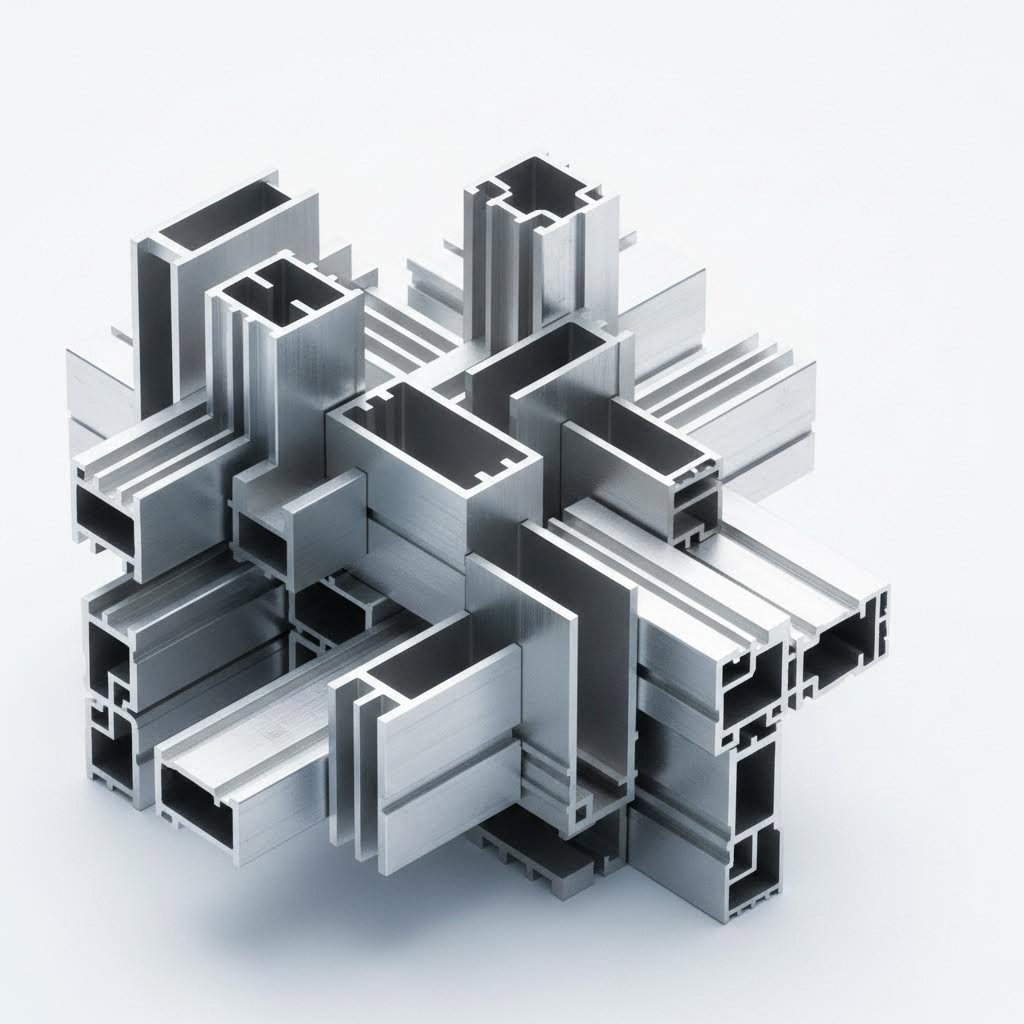
Here's where the true versatility of extruded aluminum profiles becomes apparent. Unlike casting or machining—where complexity often means exponentially higher costs—extrusion allows manufacturers to produce remarkably intricate aluminum extrusion shapes at surprisingly economical price points. The die determines everything, and once that die is made, every meter of extrusion emerges with identical precision.
Understanding the different categories of aluminum extruded shapes helps you select the right profile type for your application. It also reveals why certain designs are easier (and cheaper) to manufacture than others.
Imagine you're planning a project. Do you reach for an off-the-shelf solution, or do you invest in something purpose-built? Extruded profiles offer both paths.
Standard profiles are pre-designed shapes that extrusion manufacturers keep in regular production. They include common geometries like angles, channels, tubes, bars, and I-beams. Because the dies already exist and production runs are optimized, standard profiles offer the fastest lead times and lowest per-unit costs. According to Amfas International, these profiles power industries from automotive to electronics, offering scalable solutions for both prototyping and mass production.
Custom profiles, on the other hand, are designed specifically for your application. Need integrated mounting channels? Built-in cable management? A unique cross-section that consolidates multiple components into one? Custom extrusion profiles make all of this possible. The trade-off is die development time and tooling costs—but for medium-to-high volume production, the per-unit savings often justify the upfront investment.
The beauty of extrusion lies in this flexibility. You're not limited to simple shapes. Complex aluminium extrusion profile designs with hollow sections, thin walls, and intricate details are all achievable once you understand the fundamental profile categories.
All extrusion profiles fall into one of four primary categories based on their cross-sectional geometry:
Profile complexity directly affects manufacturing considerations. Solid profiles require simpler, less expensive dies and can be extruded at higher speeds. Hollow and semi-hollow profiles demand precision tooling and slower extrusion rates to maintain wall thickness uniformity. When designing custom profiles, understanding these categories helps you balance performance requirements against production costs.
Among the most versatile standard extrusion profiles, T-slot aluminum deserves special attention. These profiles feature characteristic T-shaped grooves along one or more sides, creating a modular building system that's transformed industrial manufacturing.
What makes T-slot profiles so valuable? As Gabrian International explains, T-slots allow you to connect a wide range of hardware to the extrusion and adjust it as needed, providing an unprecedented level of customization. The slots accept special fasteners, brackets, and connectors that slide into position and lock securely—no welding, drilling, or permanent modifications required.
Common T-slot applications include:
Structural profiles extend beyond T-slots to include I-beams, H-sections, and custom load-bearing shapes. These extrusion profiles are engineered to maximize strength while minimizing weight—a combination that makes extruded aluminum indispensable in construction and transportation industries.
The diversity of extruded profiles enables applications across virtually every industry:
Architectural Profiles:
Industrial Profiles:
What unites these diverse applications? The ability of extrusion to create consistent, precise cross-sections at scale. Whether you need architectural elegance or industrial ruggedness, the right aluminium extrusion profile exists—or can be custom-designed to meet your exact specifications.
Of course, selecting the right profile shape is only part of the equation. Understanding how aluminum extrusion compares to alternative manufacturing methods helps you determine when this process offers the best value for your specific production requirements.
So you've identified aluminum as your material of choice—but is extrusion the right manufacturing method? This question matters more than many engineers realize. Choosing between metal extrusion, casting, forging, rolling, and CNC machining can dramatically impact your project's cost structure, timeline, and final product quality.
The truth is, no single manufacturing method wins in every scenario. Each approach has distinct sweet spots where it delivers optimal value. Understanding these differences helps you make informed decisions that align with your production volume, design complexity, and budget constraints.
Let's start with the most common alternatives you'll encounter when specifying extruded metal components.
Casting involves pouring molten metal into molds, where it solidifies into the desired shape. According to DEECO Metals, casting is the preferred method for producing complex geometrical industrial parts because molten metal flows completely into all areas of a mold design. This makes casting ideal for parts requiring internal cavities or voids—think valve bodies, pump housings, and intricate engine components.
However, casting has limitations. The process may result in internal porosity, unintentional surface voids, and other imperfections. Cast parts generally aren't as tough as those created by extrusion or forging, offering lower impact and pressure resistance. If your application demands consistent material density and superior mechanical properties throughout the cross-section, extrusion metal processes often prove superior.
CNC machining takes the opposite approach—starting with solid stock material and removing everything that isn't the final part. This subtractive method offers exceptional precision and can produce virtually any geometry. But there's a catch: material waste. Machining a complex part from solid billet can mean removing 80-90% of the starting material as chips.
Metal extrusions offer a compelling middle ground. When your design features a consistent cross-section along its length, extrusion delivers near-net-shape profiles that require minimal secondary machining. You're not paying for material you'll just throw away.
Here's how aluminum extrusion stacks up against the major alternatives across key decision criteria:
| Manufacturing Method | Initial Tooling Cost | Per-Unit Cost at Volume | Design Flexibility | Surface Finish Quality | Ideal Applications |
|---|---|---|---|---|---|
| Aluminum Extrusion | Low to Medium ($500-$5,000 for dies) | Very Low | Excellent for uniform cross-sections | Very Good (accepts anodizing well) | Structural frames, architectural profiles, heat sinks, consistent-length components |
| Die Casting | High ($10,000-$100,000+) | Low at high volumes | Excellent for complex 3D geometries | Good to Very Good | Engine components, housings, complex parts with internal features |
| Sand Casting | Low to Medium | Medium | Good for large, complex parts | Fair (requires finishing) | Large industrial components, prototypes, low-volume production |
| Rolling | Very High (mill setup) | Very Low at extreme volumes | Limited to flat/sheet products | Excellent | Sheet metal, plate, coil stock for secondary forming |
| Forging | High ($15,000-$50,000+) | Medium to Low | Limited to simpler shapes | Fair (requires machining) | High-stress components, aerospace parts, automotive suspension |
| CNC Machining | Low (programming only) | High (material waste + labor) | Unlimited geometric freedom | Excellent | Prototypes, low volumes, complex one-off parts |
When does extrusion manufacturing make the most economic sense? The answer largely depends on your production volume and design characteristics.
Low volumes (1-100 pieces): CNC machining typically wins here. The absence of tooling costs means you can produce parts immediately without die investment. However, if your design uses a standard extrusion profile, purchasing off-the-shelf stock and adding secondary machining often beats starting from solid billet.
Medium volumes (100-10,000 pieces): This is extrusion's sweet spot. Die costs amortize quickly across hundreds or thousands of parts, and the per-unit savings compared to machining become substantial. As industry analysis confirms, extrusion is fast and efficient for high volumes while producing material with excellent homogeneous cross-sections.
High volumes (10,000+ pieces): Both extrusion and die casting become attractive options. The choice depends on geometry—consistent cross-sections favor extrusion, while complex 3D shapes favor casting. Roll forming may also compete for simpler profiles, particularly when using steel rather than aluminum.
Extrusion delivers maximum value in specific scenarios:
What about steel extrusion alternatives? While extruded steel profiles exist, aluminum offers compelling advantages for many applications.
According to Anglelock's engineering analysis, steel is about 3x as heavy as aluminum. While welded steel offers higher absolute tensile and yield strength, the strength-to-weight ratio tells a different story. Aluminum extrusions are lighter—so much so that they're "stronger" pound-for-pound. This allows structural designs to be lighter in weight while achieving the same strength results as steel.
The practical implications are significant:
Steel framing makes sense for applications where brute strength and vibration resistance matter more than weight—bridge construction and heavy industrial machinery, for example. But for applications prioritizing the strength-to-weight ratio, corrosion resistance, and design flexibility, aluminum extrusion frequently proves the smarter choice.
With this framework for comparing manufacturing methods established, the next question becomes: where are extruded aluminum products actually used? The answer spans virtually every industry imaginable.

What are aluminum extrusions used for in the real world? The answer might surprise you with its breadth. From the window frame in your office to critical components in commercial aircraft, extruded aluminum products touch virtually every aspect of modern life. The global aluminum extrusion market exceeded USD 90 billion in 2022, and understanding where this material gets deployed reveals why demand continues climbing.
What makes extruded aluminum so universally appealing? It's the unique combination of properties—lightweight yet strong, corrosion-resistant yet affordable, and infinitely customizable through the die design process. Let's explore how different industries leverage these advantages.
The building and construction industry currently utilizes the largest share of extruded aluminum products, and the reasons are compelling. Architects and builders need materials that deliver strength without excessive weight, resist corrosion without constant maintenance, and accept beautiful finishes that enhance building aesthetics.
Aluminum extrusion products excel across construction applications:
Why does construction favor extrusion? The ability to integrate multiple functions into a single profile—weatherstripping channels, drainage grooves, snap-fit connections—eliminates secondary operations and assembly steps. A well-designed architectural window frame might consolidate what would otherwise require five or six separate components.
When every gram matters, aluminum extrusion becomes indispensable. The transportation sector—spanning automotive, aerospace, rail, and marine applications—increasingly turns to extruded aluminum to reduce weight without sacrificing structural integrity.
Aerospace Applications:
Aircraft aluminum extrusions serve critical structural roles throughout modern aircraft. According to aerospace industry specialists, high-performance alloys like 2024, 6061, and 7075 form the backbone of airframe construction. These aluminum extruded products include:
The aerospace industry demands extraordinary quality control. Every batch of aircraft aluminum extrusions comes with full chemical composition and mechanical property reports, with materials meeting strict traceability requirements across the entire supply chain.
Automotive Applications:
Vehicle manufacturers face relentless pressure to improve fuel efficiency and reduce emissions. Aluminum extrusion provides a powerful tool for achieving these goals:
The same weight-reduction logic applies to buses, utility trailers, recreational vehicles, and marine vessels—anywhere reducing mass improves efficiency or payload capacity.
Your smartphone, laptop, and LED light fixtures all face the same challenge: electronic components generate heat that must be dissipated to maintain performance and longevity. Aluminum extrusion provides elegant solutions for this universal problem.
According to thermal management specialists, aluminum extrusions have gained prominence in heat sink applications due to their excellent thermal conductivity, lightweight nature, and ease of manufacturing. The extrusion process enables creation of heat sinks with intricate fin structures, resulting in larger surface areas that facilitate better airflow and enhanced heat dissipation.
Key electronics applications include:
Why aluminum over copper for thermal applications? While copper offers higher thermal conductivity, aluminum provides approximately 60% of copper's thermal performance at one-third the weight and significantly lower cost. For most electronics cooling applications, this trade-off favors aluminum—particularly when complex fin geometries are required.
Step onto any factory floor, and you'll encounter extruded aluminum in countless forms. The industrial sector values extrusion for its modularity, precision, and ability to create custom solutions without custom manufacturing costs.
Common industrial applications include:
The T-slot revolution has transformed industrial equipment design. Rather than welding custom steel frames, engineers now specify modular aluminum profiles that can be assembled, disassembled, and reconfigured using standard hardware. This flexibility dramatically reduces lead times and enables continuous improvement of production layouts.
While industrial and construction markets dominate by volume, aluminum extrusion products surround us in daily life. The same properties that make extrusion valuable for skyscrapers and aircraft—lightweight strength, corrosion resistance, and beautiful finishes—translate perfectly to consumer goods.
What are aluminum extrusions? At their core, they're versatile building blocks that enable designers across every industry to create stronger, lighter, more durable products. The consistent quality, design flexibility, and cost-effectiveness of extrusion explain why this manufacturing method continues expanding into new applications.
Of course, raw extrusions rarely ship directly to end users. The journey from press to finished product typically involves additional processing steps—surface treatments, secondary machining, and quality verification—that transform basic profiles into ready-to-install components.
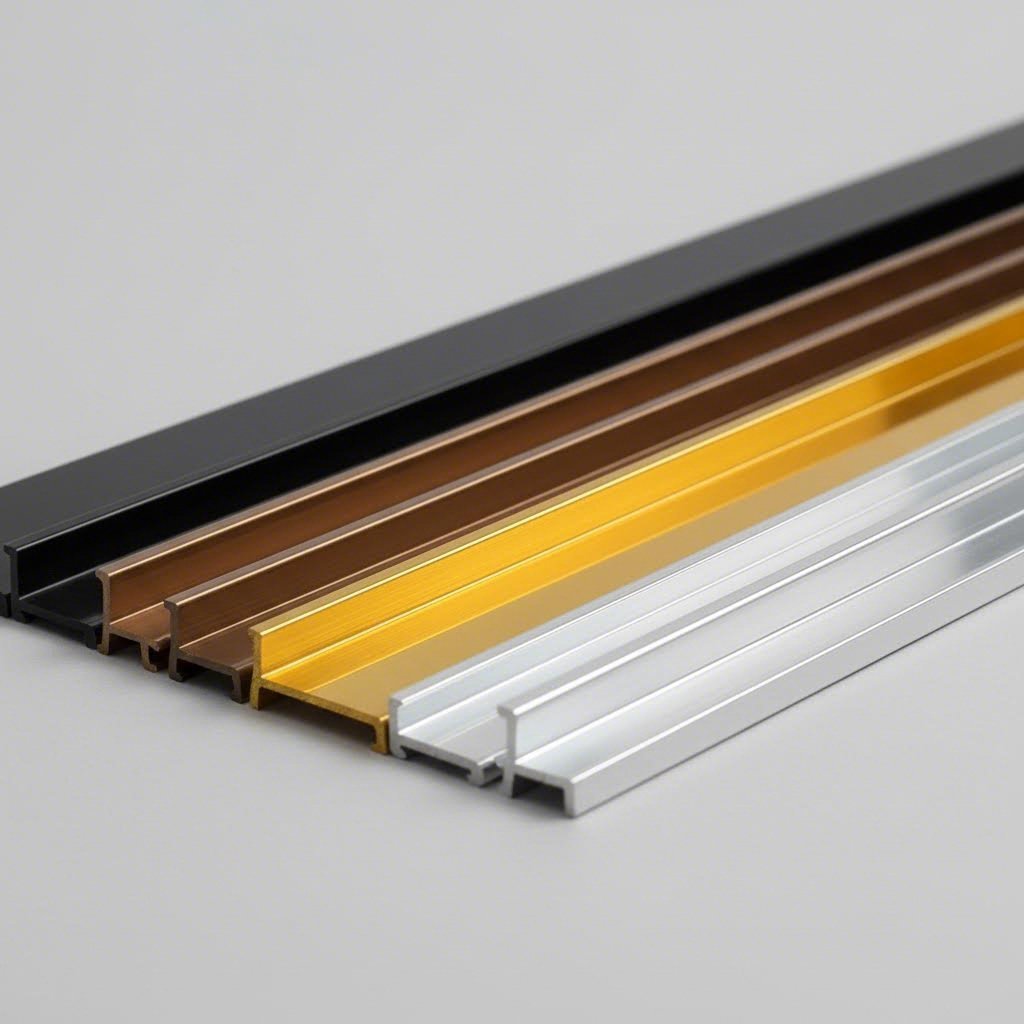
The aluminum profile emerging from the extrusion press is just the beginning. While the extruded aluminum process creates precise cross-sections with consistent dimensions, raw mill-finish extrusions are vulnerable to scratches, stains, and oxidation. Transforming these basic profiles into finished components requires additional aluminum extrusion processing steps—surface treatments that enhance durability and aesthetics, plus secondary operations that add functional features.
Understanding how extruded aluminum is made doesn't stop at the press. The finishing stages often determine whether your components will perform flawlessly for decades or fail prematurely in the field.
Surface finishing serves two critical purposes: protection and appearance. The right treatment shields aluminum from environmental degradation while achieving the visual effect your application demands. According to surface treatment specialists, three technologies dominate the finishing landscape—each with distinct advantages.
Choosing between these options depends on your specific requirements. Anodizing excels for high-end electronics and precision mechanical parts where the metallic appearance should remain visible. Powder coating suits window frames, furniture, and industrial components needing specific colors at competitive costs. PVDF is essential for monumental architecture and projects facing decades of environmental exposure.
Surface treatments address the outside—but what about the material properties within? Heat treatment processes transform the mechanical characteristics of heat-treatable alloys (primarily the 2xxx, 6xxx, and 7xxx series), enabling designers to specify strength levels precisely matched to application demands.
The two primary heat treatment approaches include:
Understanding temper effects is crucial. A 6061-T6 profile offers tensile strength around 45,000 psi, while the same alloy in T4 temper (naturally aged) provides only about 30,000 psi. Specifying the correct temper ensures your components meet structural requirements without over-engineering.
Raw extrusions arrive in long lengths with consistent cross-sections—but most applications require additional features. Aluminium extrusion machining transforms basic profiles into ready-to-install components through precision secondary operations.
Quality issues caught after finishing cost far more to address than those detected early. Effective quality control spans the entire production chain—from incoming billet inspection through final dimensional verification.
Common extrusion defects and their prevention include:
Leading manufacturers employ coordinate measuring machines (CMMs) and optical scanning systems to verify dimensional accuracy against CAD specifications. Material certifications trace each extrusion back to its source billet, ensuring full traceability for quality-critical applications.
With finishing and secondary processing complete, your extrusions are ready for assembly—but getting there requires thoughtful design decisions that account for manufacturing constraints and capabilities from the very beginning.
You've selected your alloy, chosen your finish, and identified the perfect profile shape—but will your design actually extrude successfully? This question separates experienced engineers from those facing costly redesigns. Every aluminum extrusion profile must work within the physical constraints of the manufacturing process, and understanding these limitations upfront prevents surprises that derail project timelines.
The beauty of profile extrusion lies in its flexibility—but that flexibility has boundaries. Die strength, metal flow characteristics, press capacity, and geometric proportions all impose practical limits on what's achievable. Let's explore the design parameters that determine whether your aluminum profile extrusion project proceeds smoothly or requires extensive revision.
How thin can you go? This question comes up in nearly every custom extrusion aluminum project as designers seek to minimize material costs and component weight. The answer depends on several interrelated factors—and understanding them helps you specify realistic dimensions from the start.
According to extrusion process specialists, minimum wall thickness correlates directly with the circumscribing circle diameter. Smaller profiles permit thinner walls, while larger profiles require proportionally thicker sections. Consider these general relationships:
Alloy selection also matters significantly. Moving from easy-to-extrude 6063 to harder alloys like 6082 or the 7xxx series increases minimum thickness requirements by 15-30%. The metal simply doesn't flow as readily through tight die openings, requiring more generous wall sections to ensure complete filling.
What about dimensional tolerances? Hot plastic deformation doesn't deliver the precision of CNC machining—that's an inevitable reality of the process. The EN 755-9 standard provides comprehensive tolerance specifications, but as a practical starting point:
Need tighter tolerances? Discuss specific requirements with your extruder early. While standard tolerances have margins built in, negotiated specifications—potentially with higher scrap allowances factored into pricing—can often achieve more precise results for critical dimensions.
Imagine drawing the smallest circle that completely encloses your profile's cross-section. That's the circumscribing circle diameter (CCD)—and it's the fundamental measurement determining which presses can produce your alu extrusion profile.
Why does this matter? According to the Aluminum Extruders Council, most common profiles fit within a 12-inch (300mm) CCD, while specialized extruders can produce profiles with circumscribing circles as large as 32 inches (800mm). But economics favor smaller profiles: extrusions are most cost-effective when they fit within a CCD between 1 and 10 inches, with profiles under 8 inches delivering significant cost reductions.
Press availability follows a pyramid structure—many presses handle smaller profiles, while fewer facilities operate the massive equipment needed for extra-large sections. The press availability distribution in North America shows this clearly: designing within common size ranges means more supplier options, competitive pricing, and shorter lead times.
The CCD also determines billet requirements. As a rule of thumb, the billet diameter needs to exceed the circumscribing circle by approximately 10% for open sections (slightly more for hollow profiles). This relationship, combined with container dimensions and press tonnage, establishes the maximum profile size any given facility can produce.
What separates a profile that extrudes beautifully from one that causes endless headaches? Often, it's attention to a handful of design principles that promote balanced metal flow and die longevity. The Aluminum Extruders Council recommends these good design practices:
For semi-hollow sections—profiles with partially enclosed voids—specific proportions must be maintained. The unsupported die section that forms the hollow acts as a cantilever under metal pressure. Excessively deep hollows relative to their width create bending stresses that cause premature die failure or dimensional instability.
Your aluminum extrusion die is the heart of any custom project—the precision-machined steel tool that transforms your CAD design into physical reality. Understanding die for aluminium extrusion considerations helps you budget accurately and design for manufacturability.
Die complexity directly affects aluminum extrusion tooling costs. According to industry sources, open-profile dies typically range from €1,500 to €12,000 depending on size and complexity (presses from 1,600 to 6,000 tons). Hollow-profile dies—requiring bridge construction with internal mandrels—cost substantially more: €2,200 to €27,000 depending on size and the number of internal cavities.
What drives these cost variations?
Die development also affects project timelines. While exact schedules vary by manufacturer and complexity, planning for approximately 8 weeks from design approval to first production samples provides realistic expectations for custom extrusion aluminum projects. This timeline encompasses die design, steel procurement, precision machining, heat treatment, and trial extrusion runs.
Successful aluminum profile extrusion projects start with early collaboration between designers and extruders. The reference materials emphasize this point repeatedly: involving your extrusion partner during the design phase—not after drawings are finalized—prevents costly revisions and optimizes your profile for manufacturing.
What should you discuss early?
The technological constraints we've explored aren't obstacles—they're design parameters that, once understood, empower you to create profiles optimized for both performance and production. With these considerations in mind, the final step is selecting the right manufacturing partner who can bring your design from concept to reality.
You've designed the perfect profile, selected the ideal alloy, and mapped out your finishing requirements. Now comes a decision that will determine whether your project succeeds or stumbles: selecting the right aluminum extrusion manufacturing partner. This choice extends far beyond comparing price quotes—it's about finding a supplier who functions as an extension of your engineering team.
What separates an average supplier from a truly premier aluminium extrusion manufacturer? According to industry analysis, it's a blend of cutting-edge technology, superior material selection, expert craftsmanship, and comprehensive end-to-end services. The best partners consistently deliver high-precision custom profiles meeting the strictest specifications—and they do it reliably, project after project.
Imagine designing a complex structural profile, only to discover your chosen supplier lacks the press tonnage to produce it. This scenario plays out more often than you'd expect—and it's entirely preventable with proper due diligence.
The first evaluation criterion is press range and capability. Does the manufacturer operate equipment sized for your profile's circumscribing circle? Can they handle your alloy requirements at the necessary extrusion ratios? Top-tier facilities maintain multiple presses across a range of tonnages, providing flexibility to match the right equipment to each project's demands.
Consider Shengxin Aluminium as an example of comprehensive capability. With 35 advanced extrusion presses ranging from 600T to 5500T, they can produce everything from delicate architectural trim to heavy structural sections. This breadth of equipment means your project won't be shoehorned onto an undersized press or delayed waiting for appropriate capacity.
Beyond press tonnage, evaluate these technical factors:
As sourcing specialists note, suppliers with proven experience in your industry are better equipped to understand your technical needs, anticipate challenges, and offer efficient solutions. Whether you work in transportation, construction, electronics, or renewable energy, industry-specific expertise ensures compliance with relevant standards.
Raw aluminum extrusions rarely ship directly to assembly lines. Most applications require surface finishing, precision machining, or both. Finding a partner who handles these operations in-house dramatically simplifies your supply chain.
When evaluating surface treatment capabilities, look for comprehensive options:
Shengxin Aluminium exemplifies this integrated approach, offering all four treatment technologies under one roof. Their deep processing and custom extrusion services include state-of-the-art CNC machining centers capable of precise cutting, drilling, and bending to exact specifications.
Why does integration matter? According to manufacturing experts, working with a single source for multiple steps improves consistency and saves time. When one supplier handles extrusion, finishing, and fabrication, you eliminate coordination headaches between multiple vendors—and reduce the risk of damage during inter-facility transport.
The journey from concept to production-ready aluminum extrusions involves multiple handoffs—and each transition point represents potential for delay or miscommunication. The best extrusion aluminum partners provide seamless support across every phase.
Design collaboration: Premier manufacturers engage during the design phase, not after drawings are finalized. They'll identify potential manufacturability issues, suggest profile optimizations, and help you balance performance requirements against production realities. This early involvement prevents costly redesigns that derail project timelines.
Die development: Custom extrusion dies require precision engineering and manufacturing. Expect experienced partners to manage this process transparently, providing realistic timelines and keeping you informed of progress. The 8-week timeline mentioned earlier represents typical die development—but complex profiles or unusual alloys may require additional time.
Trial runs and approval: Before committing to production quantities, reputable manufacturers produce sample extrusions for your approval. This step catches any dimensional issues or surface quality concerns before they affect thousands of parts.
Production scaling: As procurement specialists emphasize, capacity planning is critical for B2B clients with fluctuating demand. Confirm that your supplier can scale output or introduce new dies without excessive lead times. Facilities with multiple extrusion lines and automated systems often outperform smaller shops in meeting delivery windows.
Technical capability means little if you can't reach your supplier when problems arise. Responsive, knowledgeable customer service distinguishes true partners from mere vendors.
Consider these evaluation criteria:
| Evaluation Factor | Questions to Ask | Red Flags |
|---|---|---|
| Response Time | How quickly do they answer technical questions? Same-day? Within hours? | Days-long delays for simple inquiries |
| Technical Depth | Can they discuss alloy properties, tolerances, and design tradeoffs knowledgeably? | Vague answers or inability to explain manufacturing constraints |
| Dedicated Support | Will you have a consistent account manager who knows your project history? | Different contact person every call |
| Documentation | Do they provide material certifications, test reports, and full traceability? | Reluctance to share quality documentation |
| Problem Resolution | How do they handle quality issues or delivery delays? | Blame-shifting or slow escalation processes |
With over 30 years of industry experience, established custom aluminium extrusions providers like Shengxin Aluminium understand that technical support extends beyond answering emails. Their teams provide end-to-end guidance from die development through mass production—ensuring your project benefits from accumulated expertise rather than learning curves.
Don't just take capability claims at face value—verify them. Quality certifications provide independent validation that manufacturers maintain rigorous process controls.
At minimum, look for ISO 9001 certification, which confirms documented procedures for key processes and commitment to continuous improvement. For specialized applications, additional certifications matter:
Beyond certifications, ask about specific quality control practices. According to quality assurance specialists, leading manufacturers use a combination of CMMs, optical comparators, and surface profilometers to verify dimensional accuracy. Material verification through spectroscopy ensures incoming billets meet alloy specifications, while tensile testing confirms mechanical properties match requirements.
Choosing an aluminum extrusion services partner involves balancing multiple factors. Price matters—but it shouldn't overshadow capability, quality, and reliability. The cheapest quote often proves expensive when delivery delays halt your production line or quality issues trigger warranty claims.
Build a structured evaluation approach:
The right extrusion aluminum partner becomes more valuable over time—accumulating knowledge of your specifications, anticipating your needs, and proactively solving problems before they affect your operations. Invest the effort upfront to find a manufacturer who views your success as their success, and you'll build a supply chain foundation that supports growth for years to come.
Aluminum extrusion is a manufacturing process where heated aluminum billets are forced through a precision-engineered die opening to create continuous profiles with consistent cross-sections. The term comes from the Latin word 'extrudere,' meaning 'to push out.' This process enables creation of complex shapes—solid, hollow, and semi-hollow profiles—used across construction, aerospace, automotive, and electronics industries. The die shape determines the final profile geometry, allowing virtually unlimited design possibilities from simple channels to intricate heat sinks.
Aluminum refers to the raw metal or general aluminum products, while extruded aluminum specifically describes aluminum that has been processed through an extrusion press and die. The extrusion process creates profiles with uniform cross-sections along their entire length, resulting in stronger and more structurally consistent material compared to rolled aluminum. Extruded aluminum benefits from the metal flow characteristics during processing, which aligns the grain structure and enhances mechanical properties, making it ideal for structural applications requiring consistent strength.
While aluminum extrusion offers many benefits, limitations include: inconsistencies between surface layer, center, head, and tail of extrusion products; die wear from high heat and pressure affecting mold lifespan; dimensional tolerances typically around ±1% that may not suit ultra-precision applications; minimum wall thickness requirements that increase with profile size; and upfront die tooling costs ranging from $500 to $27,000 depending on complexity. Additionally, harder alloys like 7075 have reduced extrudability compared to architectural grades like 6063.
The 6000 series alloys dominate aluminum extrusion due to their excellent extrudability, strength, and corrosion resistance. The most popular include: 6063 (the 'architectural alloy') for window frames and decorative applications offering excellent surface finish; 6061 for structural components requiring higher strength; 6005 bridging architectural and structural needs for ladders and rail profiles; and 7075 for aerospace applications demanding maximum strength. Alloy selection depends on balancing mechanical requirements, surface finish needs, and manufacturing considerations.
Custom aluminum extrusion die development typically requires approximately 8 weeks from design approval to first production samples. This timeline includes die design, steel procurement, precision CNC machining, heat treatment, and trial extrusion runs. Complex profiles or unusual alloys may require additional time. Leading manufacturers like Shengxin Aluminium, with 35 extrusion presses and comprehensive in-house capabilities, can streamline this process through integrated die development and production services, reducing coordination delays between multiple suppliers.



 dịch vụ trực tuyến
 0086 136 3563 2360
 sales@sxalu.com
 +86 136 3563 2360
 Việt
Việt English
 français
 Deutsch
 русский
 español
 português
 العربية
 ไทย
ไทย Українська